
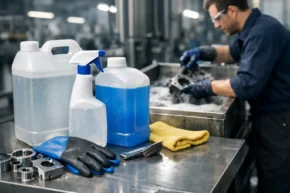
A stamped panel can look clean and still carry residual drawing compound. A machined component can pass visual inspection while coolant residue, fine chips, and shop soil remain in threads or blind holes. Those contaminants become costly when they interfere with welding, conversion coating, paint adhesion, rust prevention, assembly, or final inspection. Industrial cleaning chemicals are process materials, not a housekeeping afterthought, and their selection should reflect the soil, substrate, equipment, downstream operation, and water quality in the plant.
What Industrial Cleaning Chemicals Must Accomplish
In metalworking and heavy manufacturing, cleaning chemistry has to remove a defined contaminant without creating a new production problem. The cleaner must release oils, greases, metal fines, polishing compounds, carbonaceous residues, fingerprints, or forming lubricants. It must also maintain acceptable performance over its service life, rinse effectively, protect compatible surfaces, and fit the operating conditions of the equipment.
That requirement changes from one line to another. A low-foaming spray cleaner for a high-pressure washer has different operating needs than an immersion cleaner used before conversion coating. A process cleaning ferrous parts before applying a water-displacing rust preventative may tolerate a different surface condition than a precision cleaning operation preparing aluminum or stainless components for a critical finish.
The objective is rarely simply to make a part look bright. Effective cleaning produces a controlled surface condition for the next manufacturing step. When the chemistry, concentration, temperature, and mechanical action are aligned, plants can reduce defects that are often blamed on coating, lubrication, or material quality.
Start With the Soil, Not the Cleaner
The most practical selection question is: what is actually on the part? “Oil” is too broad to guide a reliable decision. Petroleum-based machining oils, water-miscible metalworking fluid residues, chlorinated or sulfurized extreme-pressure lubricants, waxes, soaps, and drawing compounds can respond very differently to the same cleaner.
Alkaline cleaners are commonly used where saponification, emulsification, and dispersion are needed to remove oils, greases, and many shop soils. Their performance depends on alkalinity, surfactant package, operating temperature, contact time, and agitation. Higher alkalinity can improve removal of certain heavy soils, but it may be unsuitable for sensitive aluminum alloys, zinc, galvanized surfaces, or selected coatings.
Acid cleaners and deoxidizers serve a different purpose. They may remove oxides, scale, heat tint, or inorganic residues while preparing a surface for a subsequent treatment. The trade-off is material compatibility and bath control. Excessive attack can affect appearance, dimensions, or surface condition, particularly on mixed-metal assemblies.
Solvent-based cleaning systems can be appropriate for specific oils, waxes, or water-sensitive applications. They also require close attention to ventilation, flammability, worker exposure, waste handling, and local operating requirements. A water-based process may offer easier rinsing and process integration, but it is not automatically the best answer for every contaminant.
The soil load matters as much as soil type. A cleaner that performs well on lightly oiled parts may lose effectiveness quickly when exposed to high volumes of stamping lubricant, swarf, tramp oil, or carbon residue. Evaluating cleaning chemistry without considering bath loading and oil separation can produce an optimistic result that will not hold during production.
Match the Cleaner to Metal, Equipment, and Finish
The part material defines the acceptable chemistry range. Steel and cast iron may require cleaning followed by immediate drying or temporary corrosion protection. Aluminum often requires controlled alkalinity and careful prevention of staining or etching. Copper alloys can discolor under incompatible conditions. Zinc, galvanized steel, and multi-metal assemblies require their own compatibility review.
Equipment determines how the product must behave. Immersion systems rely on time, temperature, solution movement, and bath maintenance. Spray washers need controlled foam, good wetting, and effective performance under nozzle pressure. Ultrasonic cleaning may improve removal in recessed geometries, but chemistry still needs to suspend contaminants and rinse away cleanly. Manual wipe or low-volume operations have different exposure and consistency considerations than automated lines.
Downstream requirements should be defined before a product is approved. If parts will receive phosphate, zirconium, paint, powder coat, adhesive, or weld operations, the surface must meet the requirements of that process. Residual surfactant, alkaline carryover, poor rinsing, or flash rust can reduce coating adhesion and cause avoidable rework. For parts entering assembly, the concern may be residue in precision features or interference with lubricants, sealants, and torque values.
A cleaning process should also account for the drying window. Freshly cleaned ferrous parts are highly susceptible to flash rust when humidity, rinse quality, or handling conditions are unfavorable. The right cleaner may need to work with a final rinse, drying system, or compatible rust preventative to protect surface quality between operations.
Control the Process, Not Just the Product
Even a well-formulated cleaner cannot compensate for an uncontrolled process. Plants should establish an operating range for concentration, temperature, contact time, and mechanical action, then verify those parameters on a routine schedule. Titration, conductivity, pH, temperature checks, and visual inspections can be useful, depending on the chemistry and process design.
Bath contamination needs equal attention. Free oil, suspended fines, sludge, and hard-water salts reduce effective cleaning and can redeposit onto parts. Skimmers, coalescers, filtration, settling, and scheduled bath maintenance may extend solution life, but the appropriate method depends on the contaminant and equipment. Removing free oil is not the same as managing dissolved or emulsified soil.
Rinsing is a frequent source of inconsistency. A clean wash stage followed by a contaminated rinse can leave residues that appear later as staining, poor coating performance, or corrosion. Counterflow rinsing, water-quality monitoring, and appropriate rinse replenishment help reduce carryover. Where surface-critical work is involved, rinse quality should be treated as a process variable rather than an assumed utility.
Operators also need a clear standard for acceptable cleanliness. That may include water-break behavior, wipe tests, gravimetric residue checks, surface-energy testing, appearance criteria, or downstream coating results. The appropriate test depends on the part and application. A generic visual check is seldom sufficient for a component going into a demanding finishing or assembly process.
Evaluate Cost as Total Process Cost
The lowest-priced industrial cleaner can become the most expensive choice if it requires excessive concentration, shortens bath life, creates foam, increases waste volume, or drives coating rejects. Conversely, a higher-performing formulation may reduce labor, improve line speed, lower rework, and provide more stable results across shifts.
A useful evaluation compares chemical consumption, energy demand, water use, maintenance time, waste treatment, part quality, and uptime. It should also consider the risk of an off-spec batch reaching a coating line or customer. Cleaning chemistry affects more than the wash station, so purchasing decisions should include production, quality, maintenance, finishing, and environmental health and safety personnel.
Pilot trials should use representative parts, real production soils, normal water conditions, and the intended downstream process. Laboratory screening is valuable, but it cannot fully reproduce oil loading, operator variation, equipment geometry, or line speed. Technical support during startup is especially valuable when a plant is replacing a legacy chemistry, adding a new alloy, or correcting recurring finish defects.
Build Cleaning Into the Full Manufacturing Sequence
Cleaning works best when it is coordinated with metalworking fluids, forming lubricants, heat-treating chemicals, conversion coatings, rust preventatives, and finishing materials. A difficult-to-clean lubricant may be acceptable in one process if it provides essential tool protection, but the cleaning stage must then be designed for it. In other cases, changing the upstream lubricant or adjusting application volume can reduce the cleaning burden and improve total line performance.
Nutech Company supports this broader process view by supplying specialty chemicals across multiple manufacturing stages and by applying technical service to application-specific operating conditions. The goal is not simply to select a cleaner from a catalog. It is to establish a repeatable cleaning process that supports throughput, part protection, finish quality, and practical operating value.
The most productive next step is to review a representative dirty part alongside its next operation. Identify the contaminant, the base metal, the current cleaning parameters, and the surface condition required downstream. That focused review often reveals whether the issue is chemistry, bath control, rinsing, handling, or an upstream process that is asking the cleaner to do more than it reasonably can.