
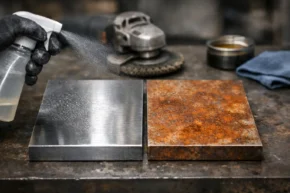
A clean steel part can show orange staining before it reaches the next operation, sometimes in less than an hour. That speed makes flash rust easy to dismiss as a cleaning problem, but the real cause is usually a breakdown between cleaning, drying, protection, and material handling. Knowing how to prevent flash rust requires controlling that entire process window, not simply adding more corrosion inhibitor.
Flash rust creates avoidable rework, inspection delays, coating defects, and customer concerns. In machining, stamping, grinding, heat treatment, and finishing operations, it can also indicate that a cleaner, rinse, metalworking fluid, or rust preventative is not matched to the actual production conditions.
What Causes Flash Rust?
Flash rust is rapid surface oxidation that develops when freshly cleaned ferrous metal is exposed to water, oxygen, and conditions that accelerate electrochemical corrosion. Cleaning removes oil, oxide, shop soil, and residual processing films. It also leaves a highly active metal surface. If that surface remains wet or carries insufficient corrosion protection, rust can form quickly.
The rate varies with the alloy, part geometry, surface finish, water quality, ambient humidity, and time between operations. Low-carbon steel and cast iron are frequent problem materials. Ground surfaces, porous castings, blind holes, seams, and tightly nested parts are also more vulnerable because they retain moisture and expose more active surface area.
A part that looks dry is not always dry enough. Residual water trapped in threads, tubing, weld seams, folds, and fixture contact areas can migrate after the part leaves the wash system. This is why flash rust may appear in packaging, at final inspection, or after a part has been moved to a different area of the plant.
How to Prevent Flash Rust Through Process Control
The most reliable approach is to treat flash-rust prevention as a linked system. The cleaner must remove soils without leaving corrosive residues. Rinse stages must limit contaminant carryover. Drying must reach recessed areas. A rust preventative must provide enough film protection for the actual storage, handling, and downstream processing requirements.
Start with the incoming surface condition
Do not evaluate the washer independently from the operation ahead of it. Excessive carryover of metalworking fluids, chlorides, salts, acidic residues, or abrasive fines can overwhelm a cleaning system and destabilize the final rinse. Certain machining coolants and drawing compounds may also leave residues that change how a corrosion inhibitor wets the metal.
Monitor cleaner concentration, alkalinity or acidity as applicable, soil loading, and bath age. A cleaner that has lost effectiveness may leave patchy soils that interfere with protection. Conversely, an overly aggressive cleaner can strip every residual protective film from the part and make the dry-to-protect interval more critical.
For difficult applications, review the full chemistry sequence: incoming lubricant or coolant, cleaner, rinse water, final-stage additive, drying method, and temporary rust preventative. The interaction between these materials often explains a flash-rust issue better than any single product measurement.
Control rinse-water quality and contamination
Final-rinse water deserves the same attention as the cleaner. Hardness, dissolved salts, chlorides, sulfates, conductivity, and microbial contamination can all affect corrosion behavior and drying quality. Water that dries with mineral residues can leave visible staining, while dissolved ionic contaminants can promote localized corrosion beneath residual moisture.
Use water quality appropriate to the part specification and subsequent process. A standard plant-water rinse may be sufficient for short in-process protection on some stamped parts. Precision-machined, ground, coated, or longer-term stored components may require better-controlled water, a corrosion-inhibited final rinse, or both.
Counterflow rinsing, timely bath maintenance, and control of drag-out help keep contaminants from reaching the final stage. If flash rust appears after a new lot of parts, a fluid change, or a water-source change, test the final rinse before assuming the rust preventative has failed.
Dry quickly, completely, and consistently
Drying is often the limiting step. Blow-off stations may remove visible water while leaving moisture in pockets and under part-to-part contact points. Heated air, convection ovens, vacuum drying, centrifugal drying, or properly designed air knives can improve results, but the right method depends on part shape, throughput, energy limits, and allowable part temperature.
Verify dryer performance at the most difficult locations, not only on open surfaces. Inspect blind holes, internal passages, sharp corners, stacked parts, and areas shadowed by fixtures. If parts are nested while still warm and damp, condensation can form inside the stack and create rust that appears to be a storage problem.
Keep the time from wash to dry to protection as short and repeatable as possible. Staging wet parts near open doors, cooling towers, steam sources, or high-humidity areas increases risk. On humid days, an otherwise acceptable process may need tighter cycle times or added temporary protection.
Select the Right Rust Preventative
A rust preventative should be selected for the protection period and the next manufacturing operation, not just for the speed of a salt-spray result. The required film may range from a light, easily removable water-displacing fluid for short indoor storage to a heavier oil, wax, or coating for extended storage and shipment.
Film type matters. Water-displacing rust preventatives can help remove residual moisture and provide a protective barrier after aqueous cleaning. Oil-based products may offer dependable indoor protection and compatibility with certain machining or assembly steps. Dry-film or waxy products can provide stronger storage protection, but they may require removal before welding, coating, painting, or precision assembly.
Application method also determines performance. Dip, spray, roll coat, and flood application can each work well when concentration, coverage, drain time, and film weight are controlled. Inconsistent coverage on edges, internal surfaces, or rack contact points is a common reason parts rust selectively.
Avoid assuming that a thicker film is always better. Excess film can create handling problems, interfere with downstream coating adhesion, attract shop contamination, or increase cleaning costs. The correct target is the minimum film that provides dependable protection through the expected exposure period.
Protect Parts During Handling and Storage
Once a clean part is protected, handling can still compromise the film. Bare-hand contact deposits moisture, salts, and fingerprints that can corrode through thin protective films. Use clean gloves where appearance or corrosion requirements are demanding, and keep racks, totes, separators, and packaging materials dry and free of corrosive residues.
Storage conditions should match the expected protection level. High humidity, temperature cycling, outdoor staging, condensation, and proximity to chemical vapors can shorten the effective life of a rust preventative. Packed parts are especially susceptible when warm material is sealed before it has cooled, since trapped humidity can condense inside the package.
For longer storage or shipment, evaluate the complete preservation system: rust preventative, interleaving material, vapor-phase protection where appropriate, package design, and warehouse environment. A good coating cannot compensate for water entering damaged packaging or parts being stored directly on a damp floor.
Diagnose the Pattern Before Changing Chemistry
The location and timing of flash rust provide useful evidence. Random rust across broad surfaces may point to inadequate final-rinse inhibition, poor drying, or insufficient protective-film coverage. Rust confined to holes, seams, or part contact points generally indicates retained water. Fingerprint-shaped marks suggest handling contamination, while rust that develops only after packaging often points to condensation or trapped moisture.
When troubleshooting, document the part material, process sequence, bath concentrations, water measurements, ambient conditions, dry time, rust-preventative application settings, and time to first visible corrosion. Compare acceptable and failed parts from the same production period. This disciplined review helps separate a chemistry issue from an equipment, timing, or handling issue.
Short trials should duplicate real production conditions rather than relying only on laboratory panels. Include the actual part geometry, rack or tote arrangement, dwell time, storage environment, and downstream requirements. A product that protects a flat coupon may not adequately cover a complex casting or a tightly bundled shipment.
Build Flash-Rust Prevention Into the Line
The strongest flash-rust programs use defined operating limits and regular verification. Operators need clear standards for bath concentration, rinse condition, dryer temperature or airflow, application settings, and acceptable dry-to-pack time. Maintenance teams need a way to identify plugged spray nozzles, failing heaters, inadequate blow-off, and contaminated tanks before defective parts accumulate.
Nutech Company can help manufacturers evaluate metalworking fluids, cleaners, conversion coatings, and rust preventatives as connected stages of a production process. Application-specific testing is especially valuable when parts must remain protected without creating problems in painting, welding, assembly, or final cleaning.
Flash rust is rarely solved by one adjustment made at the end of the line. When water quality, drying performance, temporary protection, and storage practices are aligned, clean metal stays clean long enough for the next operation to add value instead of rework.