
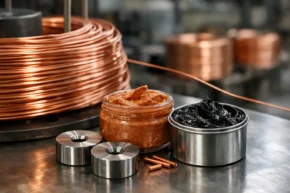
A copper wire line can show acceptable reduction rates and still lose money through die scoring, surface residue, inconsistent diameter, or downstream annealing and insulation issues. Copper wire pastes and grease are process materials, not interchangeable shop lubricants. Their chemistry, consistency, application method, and compatibility with the wire and die system directly affect drawing stability and finished-wire quality.
Nutech’s NuThix 2358 is a mineral oil based organic calcium complex corrosion inhibitor gel that can be used as a thixotropic additive or concentrate to formulate a variety of corrosion-resistant products for ferrous and non-ferrous wire.
Wire drawing creates concentrated sliding contact at the die-wire interface. As copper is pulled through progressively smaller dies, the lubricant must reduce friction while carrying heat away from the contact zone and maintaining a stable lubricating film. If that film breaks down, drawing force rises, die wear accelerates, and the wire surface becomes more vulnerable to scratches, pickup, and discoloration.
A properly selected paste or grease also needs to stay where it is applied. Material that is too fluid may be displaced before it reaches the working zone. Material that is too stiff may not feed consistently, especially as temperature changes or line speed increases. The goal is controlled replenishment at the die, not simply maximum lubricity in a laboratory test.
For copper and copper alloys, cleanliness matters as much as friction control. Residues may affect bright annealing, electrical cleaning, coating adhesion, tinning, enamel application, or insulation extrusion. A drawing lubricant must therefore be evaluated as part of the entire production route, including what happens after the wire leaves the final die.
Paste, Grease, or Another Drawing Lubricant?
The correct product family depends on the drawing operation. Paste-type compounds are often chosen where a cohesive, high-film-strength lubricant is required at the die entry. Their consistency can help keep the material in the lubrication zone during demanding reductions or when line equipment requires a product that will not readily drip or sling.
Grease-type drawing lubricants may be used where strong boundary lubrication, adhesion, and mechanical stability are needed. They can provide effective separation under high unit pressure, but they must be selected carefully for residue characteristics and application control. A grease that protects the die well but creates excessive downstream cleaning demand may increase total process cost.
For some copper wire operations, especially high-speed or multi-die systems, semi-synthetic wet-drawing fluids fluids , like NuDraw HP are the better operating choice. These systems can provide cooling, flushing, and continuous delivery that a paste or grease cannot match. That does not make paste or grease obsolete. It means the lubricant should match the machine design, reduction schedule, wire condition, and final product requirements.
Key Selection Factors for Copper Wire Pastes and Grease
The first question is what is being drawn. Pure copper, oxygen-free copper, brass, bronze, and plated conductors each present different concerns. A formulation that performs well on one alloy may leave a stain, alter surface appearance, or create an unacceptable residue on another. Copper’s surface condition before drawing also matters. Incoming rod with oxide, process soil, or variable surface texture can change how a lubricant wets and carries through the die.
Die material and die condition deserve equal attention. Tungsten carbide, polycrystalline diamond, and natural diamond dies have different surface characteristics and are commonly used at different wire sizes and process stages. The lubricant must protect the bearing surface without promoting buildup in the approach angle or accumulating debris at the die entrance. Inconsistent die polishing, worn bearings, and poor alignment will not be corrected by a heavier lubricant, although the wrong lubricant can make these problems appear worse.
Reduction per pass, total reduction, drawing speed, and wire temperature determine the required film strength and cooling capacity. Higher severity usually calls for a formulation with greater load-carrying capability, but excessive tack or viscosity can raise drag and interfere with consistent feed. The useful selection point is the lowest-friction, cleanest-running formulation that maintains a stable film under actual operating load.
Consider these process variables together:
- Wire alloy, starting diameter, and final diameter
- Die material, geometry, alignment, and maintenance condition
- Reduction schedule, line speed, number of dies and heat generation
- Application method, including die box, manual application, or automated metering
- Downstream requirements such as annealing, plating, welding, insulation, or spooling
- Cleaning capability and the plant’s acceptable residue level
A technical trial should measure more than whether the line keeps running. Track drawing force or motor load, die changes, wire breaks, surface appearance, dimensional consistency, lubricant consumption, cleanup time, and downstream reject rates. These indicators reveal the real operating value of the formulation.
Controlling Application at the Die
Even a well-formulated wire drawing compound will underperform when application is inconsistent. The lubricant needs to enter the die zone at a controlled rate and remain available throughout the run. Operators should avoid compensating for poor delivery by adding excessive material. Over-application can trap fines, increase slippage, contaminate guides and capstans, and create unnecessary cleanup.
Temperature control is particularly relevant for pastes and greases. Storage temperature changes consistency, while heat generated during drawing can change how the product feeds and shears. Maintain reasonable storage conditions, keep containers closed to prevent contamination, and use clean transfer equipment. Introducing metal fines, moisture, cleaner residue, or an incompatible lubricant can destabilize the product and complicate root-cause analysis.
Die boxes and application points should be inspected routinely for hardened buildup, blocked feed paths, and accumulated particulate. If a line develops recurring scratches or elevated drawing load, check alignment, die condition, wire cleanliness, and lubricant delivery before changing chemistry. Process problems often have more than one cause.
Managing Surface Quality and Downstream Compatibility
Copper wire is frequently specified for conductivity, surface appearance, and reliable coating performance. That places limits on lubricant additives and residue. A product that provides excellent extreme-pressure performance may not be appropriate if it leaves a film that interferes with subsequent insulation adhesion or requires aggressive cleaning before annealing.
The required finish should be defined before lubricant selection. For example, magnet wire and fine electrical conductors may demand especially clean surfaces before enameling. Conductors intended for plating or soldering may require a residue profile compatible with the planned cleaning process. If the wire will be annealed, evaluate whether lubricant carryover contributes to smoke, deposits, discoloration, or furnace maintenance.
This is why line trials should include downstream operations whenever possible. A lubricant is not fully qualified when it exits the drawing machine. It is qualified when the finished wire meets dimensional, electrical, surface, and customer requirements with controlled total cost.
When to Reevaluate the Formulation
A change in rod supplier, alloy chemistry, die supplier, wire size range, speed target, or downstream process can justify a lubricant review. The same is true when production sees gradual increases in die consumption, inconsistent bright finish, more frequent cleaning, or unexplained variability between shifts.
Nutech Company evaluates industrial lubrication requirements the full process, not as an isolated consumable purchase. That approach helps distinguish a formulation issue from an equipment, maintenance, or incoming-material condition that requires separate correction.
The most productive wire drawing programs treat lubricant selection as a controlled process decision. When the paste or grease is matched to copper grade, die system, reduction severity, and finishing requirements, it becomes a practical lever for longer die life, cleaner wire, and more predictable production.