
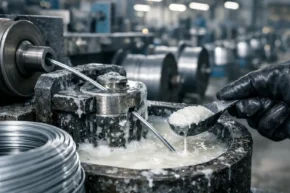
A wire break at the die is rarely just a wire problem. Excessive friction, poor lubricant carry-in, unstable concentration, residue buildup, or inadequate cooling can all raise drawing force until the process becomes unpredictable. The right wire drawing lubricants create a controlled boundary between wire and die, helping producers maintain surface quality, die life, drawing speed, and coil-to-coil consistency.
For wire producers, lubricant selection is a process decision rather than a commodity purchase. The chemistry must perform under the actual combination of material, reduction schedule, die geometry, line speed, temperature, cleaning requirements, and downstream finishing. A product that performs well on low-carbon steel at moderate speed may not be appropriate for stainless steel, galvanized wire, aluminum, copper, or fine-wire operations.
What Wire Drawing Lubricants Must Do
Drawing reduces a rod or wire diameter by pulling it through one or more dies. The interface sees high unit pressure, localized heat, and continuous metal deformation. Lubrication must lower friction without interfering with the mechanical control needed to pull the wire through the die.
An effective drawing compound provides lubricity and film strength at the die contact zone. It also helps control heat, protects dies from abrasive wear, and supports a uniform surface finish. In wet-drawing operations, the lubricant system must additionally maintain cooling, rinse away fines, and remain stable in a circulating bath.
The operational impact is direct. When lubrication is insufficient or inconsistent, drawing loads rise, dies wear faster, and the wire surface can show scoring, chatter marks, pickup, or discoloration. Break frequency may increase, especially in demanding reductions or smaller diameters. On the other hand, excessive residue or a lubricant that is difficult to remove can create problems in annealing, coating, plating, welding, or other downstream operations.
The goal is not simply maximum lubricity. It is the correct balance of lubricity, cooling, cleanliness, corrosion control, and process stability.
Main Types of Wire Drawing Lubricants
Wire-drawing chemistry is generally selected around the drawing method and workpiece material. Product form matters because it affects how the lubricant reaches the die, how it carries away heat, and how it is managed on the production floor.
Dry Drawing Soaps and Powders
Dry drawing lubricants are commonly used in ferrous wire production, particularly where substantial reductions and high loads require a durable lubricating film. These products may be supplied as soaps, powders, or granular compounds. The incoming wire typically carries a compatible conversion coating or carrier layer that helps retain lubricant as it enters the die.
A properly matched dry soap can provide strong film formation and load-carrying performance. It can be especially effective in multi-die drawing where wire temperature and reduction demands build through the line. The trade-off is residue management. Soap selection must account for the next process, including annealing, coating, welding, or cleaning. Poor compatibility between the carrier coating and drawing soap can lead to uneven pickup, die deposits, and variable performance.
Wet Drawing Fluids
Wet drawing fluids are used in enclosed or recirculating systems, including many fine-wire and nonferrous applications. They may be formulated as soluble, synthetic, semi-synthetic, or specialty lubricating systems depending on the workpiece and required finish.
In addition to lubrication, wet systems provide cooling and transport wear particles away from the drawing zone. They can support fast line speeds and controlled surface appearance when concentration, water quality, filtration, and temperature are maintained. However, wet systems require active fluid management. Concentration drift, microbial activity, tramp oil, metal fines, and hard-water contamination can change lubricity and bath stability over time.
Specialty Coatings and Carrier Systems
Some drawing operations depend on pretreatment and carrier chemistry as much as the drawing lubricant itself. Conversion coatings, reactive coatings, and polymeric carriers can improve lubricant adhesion and provide added protection during severe reductions. These systems are common when processing conditions demand a reliable film under high pressure or when the base metal is prone to galling.
The full process should be evaluated as a system: incoming surface condition, cleaning, coating or carrier application, lubricant, drawing dies, and post-draw removal. Optimizing only one stage can shift the problem downstream rather than solve it.
Selecting Lubricants for the Actual Drawing Process
Material is the first selection factor. Carbon steel, stainless steel, copper, aluminum, and alloy wire each present different friction, heat-transfer, surface-reactivity, and cleanliness requirements. Steel drawing often calls for high-pressure film strength and compatible carrier coatings. Nonferrous materials may place greater emphasis on stain prevention, cleanliness, and the ability to support bright finishes.
The reduction schedule is equally important. A light single-pass reduction has different demands than a multi-pass operation with aggressive total reduction. More severe drawing generally increases the need for film durability, heat control, and stable lubrication across multiple dies. Die material and geometry also matter. Tungsten carbide, polycrystalline diamond, and natural diamond dies can respond differently to lubricant chemistry, particulate contamination, and surface deposits.
Line speed changes the thermal load. At higher speeds, a lubricant may need improved cooling, better wetting, and greater resistance to film failure. A product that reduces friction at low speed can still underperform if it cannot manage the heat generated in production. Conversely, a lubricant designed for very high-speed operations may be unnecessary for slower lines and can introduce avoidable cost or cleanup requirements.
Downstream requirements should be established before qualification. If the wire will be galvanized, plated, welded, painted, coated, annealed, or used in a cleanliness-sensitive application, the lubricant must be evaluated for removability and residue behavior. This is particularly important when a drawing compound is being changed to address die life or speed. Gains at the draw bench should not create defects in finishing or assembly.
Managing the Process Around the Lubricant
Even well-formulated wire drawing lubricants cannot compensate for poor bath control, damaged dies, inconsistent incoming rod, or ineffective filtration. Process discipline is what turns lubricant performance into repeatable production results.
For wet drawing, establish routine checks for concentration, pH where applicable, temperature, conductivity, contamination, and fluid appearance. The correct monitoring schedule depends on the production volume and chemistry, but waiting for wire breaks or surface defects is too late. Filtration should be sized to remove fines without stripping functional components from the bath. Water quality deserves the same attention. High hardness can destabilize certain products, create deposits, or alter emulsion behavior.
For dry drawing, inspect lubricant feed, box condition, wire coverage, and die deposits. Uneven lubricant delivery can cause one die to run hot while the rest of the line appears normal. Monitor drawing force or motor load where available. A gradual increase may signal worn dies, reduced lubricant effectiveness, changes in incoming coating weight, or surface contamination on the rod.
When troubleshooting, connect symptoms to measurable process data. Surface scoring may indicate die damage, abrasive fines, poor filtration, or insufficient film. Sticky deposits can suggest overapplication, incompatible chemistry, overheating, or inadequate cleanup. Frequent breaks can result from lubrication failure, but they can also originate with mechanical alignment, material variation, or excessive reduction. The most effective corrective action comes from evaluating the entire line rather than assuming the lubricant is the sole cause.
Technical Service Has a Practical Role
A wire drawing lubricant should be qualified on production conditions, not only against a product data sheet. Plant trials should compare drawing force, die condition, wire surface, bath life, cleanup performance, and downstream compatibility. Total cost includes more than price per pound or gallon. It includes consumption, scrap, die changes, maintenance time, fluid disposal, production interruptions, and the labor required to manage the system.
Nutech Company works with industrial manufacturers that need drawing compounds and supporting process chemistry matched to demanding metalworking operations. Where a standard formulation is not the best fit, application-specific development and technical evaluation can help identify the chemistry and controls that support reliable output.
A productive next step is to document the current wire material, die sequence, reduction schedule, operating speed, lubricant consumption, surface requirements, and top three production losses. That information gives a technical team a practical starting point for improving the drawing process without creating new issues at the next stage.