
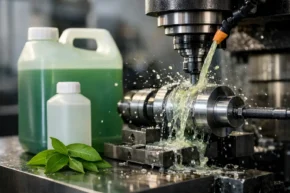
A fluid can carry an environmental claim and still fail the production floor. If it does not control heat, protect finished surfaces, resist microbial degradation, or maintain stable performance in the sump, the result is scrap, downtime, and higher operating cost. Biodegradable metalworking fluids must be evaluated as process chemicals first, with environmental characteristics assessed alongside the lubrication, cooling, corrosion-control, and maintenance requirements of the operation.
For machine shops, fabricators, and production plants working to reduce environmental impact, the right formulation can support both objectives. The key is matching the fluid chemistry to the application, metallurgy, water quality, equipment, and fluid-management practices.
What Makes a Metalworking Fluid Biodegradable?
Biodegradability describes the ability of a material to be broken down by microorganisms under defined conditions. It does not automatically mean a fluid is nonhazardous, universally drain-disposable, or suitable for every machining process. Those are separate questions involving product composition, local regulations, wastewater controls, and the specific disposal stream.
In metalworking, biodegradable formulations may use selected renewable or synthetic ester base stocks, vegetable-derived components, and additive systems designed to provide lubricity while improving environmental profile. The term is most often associated with neat oils and forming lubricants, but water-dilutable products can also be formulated with biodegradable components.
Plant personnel should ask for documentation that identifies the test method and basis for any biodegradability claim. A result generated under a recognized test protocol provides more useful information than a broad marketing description. It is also necessary to review whether the product contains materials that affect waste classification, operator exposure controls, downstream treatment, or customer requirements.
Where Biodegradable Metalworking Fluids Fit Best
The strongest fit depends on the process. High-lubricity operations, especially where a traditional petroleum product may create environmental handling concerns, are often good candidates for evaluation. Sawing, drilling, tapping, thread rolling, cold forming, stamping, and certain machining applications can benefit from ester-based or other biodegradable chemistries when the product is engineered for the required load and surface finish.
For water-miscible machining and grinding fluids, the decision is more complex. A plant may prioritize low residue, hard-water stability, foam control, operator acceptance, biological resistance, and compatibility with automated fluid-management equipment. Biodegradability can be part of the selection criteria, but it should not displace those operating requirements.
The metal being processed also matters. Aluminum, copper alloys, cast iron, carbon steel, stainless steel, titanium, and nickel alloys each present different risks involving staining, corrosion, boundary lubrication, chip removal, and tool wear. A biodegradable fluid that performs well on low-carbon steel may not provide adequate extreme-pressure performance for deep-hole drilling in stainless steel or difficult nickel alloys.
Performance Still Defines the Value
A biodegradable formulation should be judged by the same manufacturing outcomes as any other metalworking fluid. The fluid must remove heat effectively, create a durable lubricating film at the tool-workpiece interface, carry chips away from the cut, and protect parts and machine components from corrosion.
In machining, inadequate lubricity shows up quickly through shortened tool life, built-up edge, poor finish, higher spindle load, and dimensional variation. In grinding, the fluid must cool efficiently, wet the wheel and work surface, control foam, and help prevent burn or wheel loading. In forming and stamping, film strength and boundary lubrication are central to preventing galling, scoring, and die wear.
Ester-based chemistry can offer excellent lubricity and strong affinity for metal surfaces. That benefit can improve surface quality and reduce friction in many applications. However, ester-containing fluids may require careful attention to hydrolytic stability, water contamination, oxidation conditions, and compatibility with certain paints, seals, or machine components. The correct balance depends on the formulation and the operating environment, not simply on whether the base stock is renewable.
Evaluate the Whole System, Not Only the Fluid
A controlled trial should establish performance targets before conversion. Track tool life, cycle time, surface finish, part cleanliness, corrosion protection, fluid concentration, foam, odor, tramp-oil rejection, and sump condition. Include maintenance labor and waste volume in the evaluation because a lower-use-cost fluid can create value even if its purchase price is higher.
Water quality deserves particular attention for soluble and semi-synthetic fluids. Excessive hardness can affect emulsion stability and residue, while chlorides and sulfates may increase corrosion concerns. Water source, make-up practices, and concentration-control methods should be reviewed before assigning poor results to the new product.
Fluid Management Determines Long-Term Results
Even a well-formulated biodegradable metalworking fluid can underperform when fluid management is inconsistent. Concentration that runs too lean can reduce lubricity and corrosion protection. Concentration that is too rich can increase residue, foam, product consumption, and cleaning difficulty. Refractometer readings should be interpreted using the product-specific correction factor rather than assumed to represent true concentration directly.
Tramp oil control is equally important. Hydraulic leaks, way lubricants, spindle oils, and contaminated chips can introduce foreign oil into a sump. This contamination can interfere with cooling, support microbial growth, create smoke or mist, and shorten fluid life. Skimming, coalescing, filtration, and leak correction are practical parts of protecting the fluid investment.
Plants should also maintain disciplined make-up practices. Adding concentrate directly to a machine sump or topping off with untreated water can destabilize the system. Preparing make-up fluid at the correct concentration, using suitable water, and monitoring pH, concentration, conductivity where applicable, and biological activity helps maintain consistent operation.
A Practical Conversion Process
Changing to biodegradable metalworking fluids should be managed as a process change, particularly in high-volume or tightly specified production. Start with one defined operation where the current fluid presents a measurable improvement opportunity, such as excessive mist, difficult waste handling, poor lubricity, or customer-driven environmental requirements.
Before the trial, document the baseline process. Record the current fluid type and concentration, workpiece material, tooling, speeds and feeds, coolant delivery method, average tool life, reject rate, surface-quality requirements, and maintenance history. This information gives the trial a meaningful comparison point.
Next, assess machine and system condition. Old sump residue, microbial contamination, accumulated fines, and tramp oil can distort results. A proper cleanout may be necessary before conversion, especially when changing fluid families. Compatibility should also be reviewed for elastomers, machine coatings, filters, mist collectors, wastewater treatment equipment, and any downstream wash or coating operation.
Run the trial long enough to observe both immediate cutting performance and fluid stability over time. A favorable result on the first shift is useful, but it does not prove that the fluid will remain stable through normal contamination, make-up cycles, temperature changes, and production variation. Technical service should help define acceptance criteria and review the data with production, maintenance, quality, and EHS personnel.
Environmental Claims Require Operational Discipline
A biodegradable product does not eliminate disposal obligations. Used metalworking fluid may contain metal fines, tramp oil, cleaners, process soils, or other contaminants that change how it must be handled. Plants should continue to follow applicable federal, state, and local requirements as well as their own waste-management procedures.
The operational opportunity is broader than disposal. A properly selected fluid may help reduce reliance on certain conventional chemistries, improve workplace conditions, support customer sustainability initiatives, or simplify environmental objectives within a broader manufacturing program. Those gains must be verified in the context of actual plant performance.
Nutech Company works with manufacturers that need metalworking chemistry aligned with demanding production conditions. Product selection should account for the complete process, including machining or forming performance, corrosion protection, cleaning, waste handling, and technical support requirements.
The best next step is not a wholesale conversion based on a label claim. It is a focused evaluation on a demanding but controllable operation, supported by clear measurements and disciplined fluid management. That approach gives a biodegradable fluid the opportunity to prove its value where it matters most: on the part, at the machine, and across the operating cost of the process.