
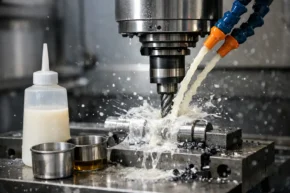
A machine shop may see fluid usage climb long before it sees an obvious machining problem. Excessive top-off rates, frequent sump dumps, mist loss, corrosion complaints, and inconsistent concentration are all signals that the operation needs attention. To reduce metalworking fluid consumption without sacrificing tool life, finish quality, or production speed, manufacturers need to manage the entire fluid system rather than focus only on the product in the sump.
Fluid consumption is not simply a purchasing issue. It affects wastewater volume, labor requirements, machine availability, housekeeping, worker exposure, and the consistency of finished parts. The most effective programs begin with measurement, then address the specific reasons fluid is leaving the process or becoming unusable.
Start With a Baseline for Fluid Use
Before changing chemistry or maintenance practices, establish where fluid is being consumed. Monthly purchase records are useful, but they do not identify whether fluid is being carried out on parts, lost to evaporation, removed with chips, discharged through leaks, or discarded because of contamination.
Track each machine or fluid system by recording sump volume, makeup-water additions, concentrate additions, concentration readings, tramp-oil removal, chip hauling, and dump frequency. For central systems, break data down by department or machine group where practical. A simple consumption rate expressed as gallons per production hour, part, or pounds of metal processed can reveal systems that deserve investigation.
Concentration should be measured with a calibrated refractometer and interpreted using the correct product factor. A refractometer reading alone is not necessarily the true concentration. Confirm readings with periodic laboratory testing, particularly where hard water, cleaners, salts, or other contaminants may influence results.
Control Concentration to Reduce Metalworking Fluid Consumption
Overconcentration is one of the most common and expensive causes of unnecessary fluid use. Water evaporates during machining, grinding, and recirculation, while the fluid concentrate generally remains behind. If operators routinely add premixed coolant at the target concentration to replace evaporation, the sump gradually becomes too rich.
An overly rich fluid can increase residue on parts and machines, contribute to mist, affect downstream cleaning, and raise concentrate cost. It can also create the impression that a fluid is failing when the actual problem is concentration control.
For evaporation losses, add water or very lean makeup fluid according to the operating target and the system’s measured concentration. For carryout losses, a stronger makeup mix may be appropriate because both water and concentrate are leaving with parts and chips. The correct makeup concentration depends on the type of loss, which is why routine testing and documented adjustment practices matter.
Automatic proportioning equipment can improve consistency in large or high-volume operations, but it still requires verification. Incorrect water pressure, worn injectors, uncalibrated meters, or changes in incoming-water quality can produce an off-spec mix. Manual mixing can work well in smaller operations if responsibilities, testing intervals, and acceptable ranges are clearly defined.
Keep Contamination From Shortening Sump Life
A properly selected metalworking fluid can provide long service life, but contamination often determines when it must be replaced. Tramp oil is a frequent offender. Hydraulic leaks, way lubricants, spindle oils, and greases can form a surface layer that restricts oxygen transfer, promotes microbial activity, creates smoke or odor, and interferes with fluid performance.
Repairing leaks is the first priority. A skimmer, coalescer, belt system, or centrifuge can help remove oil that enters despite good maintenance. The appropriate equipment depends on sump size, oil loading, fluid type, production schedule, and whether the operation uses individual machines or a central system. Removal equipment should be sized for the actual contamination load, not selected only on nameplate capacity.
Fine metal particles, grinding swarf, abrasive fines, and sludge also reduce usable fluid life. These materials can accelerate pump wear, plug filters, damage seals, scratch parts, and provide surfaces where contamination accumulates. Effective filtration is especially important in grinding, honing, and operations with fine particulate generation.
A practical contamination-control program addresses four areas:
- Hydraulic, way-lube, and coolant-system leaks
- Tramp-oil removal and scheduled surface cleaning
- Chip, swarf, and fine-particle filtration
- Separation of incompatible cleaners, oils, and process chemicals
Do not overlook wash water or cleaner drag-in. A small amount of an incompatible cleaner can destabilize a fluid emulsion, alter foam behavior, or affect corrosion protection. Reviewing the sequence from machining through washing, finishing, and rust prevention often identifies sources that are not visible at the machine.
Reduce Carryout on Parts and Chips
Fluid that leaves the sump on chips and finished parts represents a direct loss. Carryout cannot be eliminated completely, but it can often be reduced with changes to machine practice and material handling.
Allow parts and chips adequate drain time before transfer. Position conveyors, baskets, and chip hoppers so liquid returns to the machine where possible. Chip wringers, crushers, and centrifuges can recover meaningful volumes of fluid in high-volume machining operations, while also reducing the weight and disposal cost of chip loads.
Part geometry matters. Deep cavities, threads, blind holes, and complex castings retain more fluid than simple external surfaces. In these applications, air knives, blow-off stations, orientation changes, and controlled dwell time can reduce dragout. The balance is important: aggressive air use can increase mist, and excessive blow-off may create housekeeping or worker-exposure concerns. Evaluate recovery methods in the context of ventilation and enclosure performance.
Fluid viscosity and concentration also influence carryout. A heavier film may improve lubrication in difficult tapping, broaching, forming, or machining operations, but it can increase material retained on parts and chips. The right answer is not always a lower-viscosity product. The process must retain enough lubricity and boundary-film protection to prevent tool wear, built-up edge, poor finishes, or scrap.
Address Mist, Foam, and Mechanical Losses
Visible mist is not only an environmental health and safety concern. It can represent continuing fluid loss and can contaminate machine surfaces, floors, electrical components, and nearby equipment. Review nozzle placement, flow rate, pressure, and tool engagement before assuming the fluid itself is the problem.
Coolant delivered at excessive pressure or aimed poorly at the cutting zone may atomize instead of reaching the tool-workpiece interface. Better nozzle alignment can often improve cooling and lubrication while lowering pump demand and mist generation. Enclosures, door seals, and properly maintained mist collectors are equally important for capturing airborne fluid.
Foam can create a similar loss mechanism. High agitation, air entrainment from leaks on the suction side, excessive pressure, unsuitable water quality, or chemical contamination can all contribute. Antifoam additives may provide short-term relief, but repeated addition without finding the root cause can create further stability concerns. Investigate mechanical aeration and water quality first.
Match the Fluid to the Operation
Using one fluid across many machining and grinding operations may simplify purchasing, but it can create avoidable consumption if the product is not well matched to the most demanding processes. A fluid that requires high concentration to prevent staining, tool wear, or foam may be less economical than an application-specific formulation that performs at a lower, more stable range.
Evaluate the material being machined, cutting severity, tool speed, pressure, water quality, required corrosion protection, downstream cleaning, and compatibility with coatings or rust preventatives. Aluminum, high-strength steels, cast iron, stainless alloys, and yellow metals each introduce different lubrication, staining, and corrosion-control requirements.
For example, a grinding operation may benefit from a fluid designed for low foam, fine-particle control, cooling, and clean wetting. A severe machining or forming application may need stronger lubricity and extreme-pressure performance. The goal is to select chemistry that holds performance at the intended concentration, not to compensate for an unsuitable product by continually adding concentrate.
Nutech Company, LLC can support this evaluation with metalworking fluid selection and technical service that considers the complete production sequence, including cleaning, corrosion protection, and waste-management requirements.
Build a Maintenance Routine That Operators Can Execute
Fluid-management programs fail when they depend on undocumented decisions made under production pressure. Operators and maintenance personnel need clear instructions for testing, makeup additions, tramp-oil removal, filter service, and escalation when readings fall outside control limits.
Assign ownership for each system and use a visible service log, whether paper-based or digital. Record concentration, pH where relevant, odor, appearance, conductivity when applicable, fluid level, tramp-oil condition, and corrective actions. Trend data is more valuable than isolated readings. A gradual concentration drift or repeated increase in makeup demand can identify a leak, carryout problem, or mechanical issue before it leads to a full sump dump.
Periodic fluid analysis adds another level of control. Laboratory testing can help identify reserve alkalinity, microbial activity, chloride contamination, water hardness effects, corrosion tendency, and changes in fluid condition that are not apparent during routine checks. The appropriate test schedule depends on system volume, process severity, and the cost of an unplanned fluid change.
Lower consumption should never mean running a fluid beyond its useful service life. The right objective is controlled, stable fluid performance with fewer unnecessary additions and fewer premature disposals. When concentration, contamination, carryout, and application fit are managed together, fluid becomes a more reliable production asset rather than a recurring source of cost and disruption.