
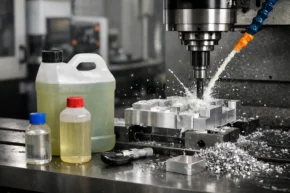
Aluminum rarely fails because a shop selected a fluid with too little lubricity on paper. It fails when the fluid does not control built-up edge, carry heat from the cut, protect mixed-metal equipment, or leave parts clean enough for the next operation. The best metalworking fluids for aluminum are therefore application-specific systems that balance lubricity, cooling, residue control, corrosion protection, and fluid life.
For production teams, the objective is not simply to find an aluminum-compatible coolant. It is to establish a Metal Working Lubricant that supports stable cycle times, predictable surface finish, tool life, clean parts, and controlled operating cost across the full process.
What Makes Aluminum Different in Metalworking
Aluminum is soft relative to steel, highly conductive, and prone to adhesion at the cutting edge. Under inadequate lubrication, material welds to the tool, forming built-up edge. The result can be poor finish, dimensional variation, burr formation, excess tool wear, and unplanned tool changes.
Heat is also a more complex issue than it may appear. Aluminum moves heat quickly away from the cutting zone, but high-speed machining, deep pockets, drilling, and tapping can still generate enough localized temperature and friction to smear material onto the tool. A fluid must wet the cut rapidly, cool effectively, and provide sufficient boundary lubrication where the tool contacts the workpiece.
The alloy and downstream requirements matter. Common 6xxx-series alloys generally machine cleanly with a well-maintained water-miscible fluid. Higher-copper aerospace alloys, castings, and parts headed for welding, anodizing, painting, or bonding may impose tighter limits on staining, residue, and additive selection. A fluid that performs well in one aluminum operation may complicate finishing in another.
Best Metalworking Fluids for Aluminum by Operation
There is no single fluid type that is best for every aluminum process. The correct choice depends on cutting severity, machine configuration, alloy, part-cleanliness requirements, and the fluid-management discipline available on the shop floor.
Water-Miscible Soluble Oils for General Machining
High-quality soluble oils remain a practical choice for general aluminum milling, turning, sawing, and moderate drilling. Their emulsion structure provides useful lubricity while the water phase delivers the cooling needed for sustained production. They are often a strong fit for shops running aluminum alongside steel, cast iron, or other materials on the same equipment.
For aluminum, the key is selecting a formulation that resists staining and does not promote corrosive attack on sensitive alloys. The emulsion should remain stable at the operating concentration and local water quality. An overly lean mix can sacrifice lubricity and corrosion control, while an overly rich mix can leave excess residue and increase carryoff cost.
Semisynthetic Fluids for Cleanliness and Versatility
Semisynthetic metalworking fluids are frequently the best balance for mixed, high-throughput machining environments. They generally offer cleaner operation and lower residue than traditional soluble oils, while retaining more lubricity than fully synthetic systems. In aluminum CNC machining, this can support consistent finishes and reduce the tendency for chips and deposits to accumulate in machine interiors.
A properly formulated semisynthetic is particularly useful where parts move directly to washing, assembly, welding, or finishing. The trade-off is that severe tapping, reaming, broaching, and low-speed high-pressure operations may require more boundary lubrication than some semisynthetics can provide. Additive chemistry and concentration must be matched to the actual cut, not just the base fluid category.
Synthetic Fluids for High-Speed and Grinding Operations
Synthetic fluids are often preferred where cooling, cleanliness, visibility, and low foam are the primary demands. They can perform well in high-speed machining of aluminum, light-duty cutting, and certain grinding operations where heat removal is more important than extreme lubricity.
Their clean-running character can improve sump visibility and reduce sticky deposits. However, a synthetic fluid is not automatically the right answer for aggressive aluminum machining. If the process has high unit pressure at the cutting edge, such as deep-hole drilling or form tapping, evaluate tool life and finish carefully. The absence of enough lubricity can show up quickly as pickup on the tool.
Straight Oils for Severe Cutting and Forming
Neat cutting oils provide the strongest lubricating film for many severe aluminum operations. Tapping, threading, broaching, deep-hole drilling, and difficult forming processes can benefit from their ability to prevent galling and material transfer. In precision work, a straight oil may produce the most reliable finish and tool life.
The operating trade-offs are significant. Straight oils do not provide the cooling capacity of water-miscible fluids, may create more mist or smoke if used outside their intended speed range, and can require more rigorous cleaning before finishing. Selection should also account for workplace exposure controls, part handling, and whether residues will affect welding, coating, or assembly.
Match the Fluid to the Failure Mode
Fluid selection becomes more reliable when the team starts with the production problem rather than a generic product category. A poor surface finish with aluminum welded to the insert points toward insufficient lubricity, poor delivery to the cutting zone, dull tooling, or excessive cutting parameters. Raising concentration may help, but it will not correct a nozzle that cannot reach the tool-work interface.
Staining or discoloration should trigger a review of alloy sensitivity, fluid chemistry, water quality, concentration, time before washing, and storage conditions. Parts can also stain after machining because of contact with contaminated racks, chips, cleaners, or mixed-metal residues. The coolant is one possible cause, not the only cause.
Excessive foam is often a system condition rather than a product defect. High-pressure delivery, soft water, air entrainment, low sump levels, tramp oil, and inappropriate concentration all affect foam behavior. A fluid designed for aluminum machining still needs to be matched to pump pressure, tank volume, and return-flow design.
When evaluating candidates, production teams should compare four operating measures:
- Tool life and the frequency of edge buildup or chip welding.
- Surface finish, burr levels, and dimensional consistency.
- Fluid stability, foam control, odor, and residue in the machine.
- Part cleanliness and compatibility with washing, welding, coating, or anodizing.
These measures create a better basis for selection than product price per gallon. A lower-cost fluid that shortens tool life, causes finishing rejects, or requires frequent sump intervention is not delivering lower total operating cost.
Fluid Management Determines Aluminum Performance
Even a well-formulated aluminum fluid will lose performance when concentration and contamination are uncontrolled. Refractometer checks should be performed using the product’s correction factor, with readings tracked against the concentration range established for the operation. Makeup should be prepared consistently. Adding concentrate directly to a sump without adequate mixing can destabilize the system and create local overconcentration.
Tramp oil deserves regular attention. Hydraulic leaks, way lubricants, and spindle oils reduce fluid wetting, encourage microbial growth in water-miscible systems, and can interfere with downstream cleaning. Skimming, coalescing, and prompt leak repair protect fluid life and part quality.
Water quality is equally influential. High hardness can destabilize some emulsions and contribute to deposits. Very soft water may increase foaming. A technical review should include the incoming water profile, not merely the coolant concentrate. Shops that run several machines from a central system need an even more disciplined approach because contamination and concentration errors spread faster.
Evaluate the Full Production Route
The best choice for aluminum machining must work beyond the machine tool. A fluid that protects a cutter but leaves a residue that interferes with welding or anodizing has shifted cost downstream. Likewise, a clean-running low-residue fluid may not be economical if it cannot protect a tap in a high-torque operation.
A productive evaluation uses representative parts, production tooling, normal coolant pressure, and actual cycle times. Inspect the tools for aluminum pickup, compare surface finish and burr condition, and verify that parts pass cleaning and finishing requirements. Trial duration should be long enough to reveal sump stability, foam behavior, and corrosion conditions on fixtures and machine components.
Nutech Company can support this type of application review with Metal Working Lubricants formulated around process demands, along with the technical service needed to evaluate performance at the machine and across downstream operations.
The most effective aluminum fluid program is one that treats coolant as a controlled production variable. When formulation, concentration, delivery, water quality, and downstream compatibility are aligned, aluminum machines cleaner, tools last longer, and finishing problems are less likely to reach the next department.