
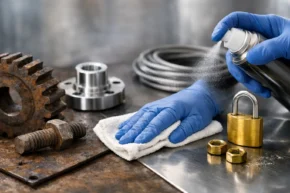
A part can leave a washer visually clean and still fail hours later. Flash rust on steel, water spotting on aluminum, tarnish on copper, and poor coating adhesion usually point to the same issue: the cleaning and protection stages were treated as separate decisions. Ferrous and non ferrous metal cleaning and protecting must be managed as one controlled process, from incoming soil through final packaging or the next production operation.
For industrial operations, the objective is not simply a bright-looking surface. Nutech has soak , spray and ultrasonic cleaners for all ferrous and non-ferrous materials. The NuFilm line of rust preventative and corrosion inhibitors will ensure your clean processed parts will get to the next operation in good condition. Nutech cleaners and inhibitors will ensure process-ready parts will have contaminant levels, corrosion resistance, and film characteristics appropriate for what happens next. That may mean machining, welding, heat treating, painting, assembly, storage, or shipment.
Start With the Metal, Soil, and Next Operation
A cleaner that performs well on carbon steel may stain aluminum, darken copper alloys, or leave a residue that interferes with a conversion coating. Likewise, a rust preventive that protects machined steel through ocean transit may be unnecessary, difficult to remove, or incompatible with a water-based finishing line.
The correct chemistry depends on three connected variables: the base metal and alloy, the contamination being removed, and the required condition after cleaning. Production teams get better results when they define all three before choosing a product or setting a washer concentration.
Ferrous metals such as carbon steel, alloy steel, cast iron, and many tool steels are generally vulnerable to oxidation when moisture, oxygen, salts, and residual process chemistry remain on the surface. Cast iron creates an additional challenge because its porous structure can retain machining fluid, abrasive fines, and cleaner residues. A cleaning process that removes visible oil but leaves salts in pores can still produce rust or bleed-out during storage.
Non ferrous metals require different controls. Aluminum can be etched by excessive alkalinity or long exposure times. Copper and brass can discolor or tarnish when exposed to unsuitable cleaner chemistry, poor rinse water, or reactive residues. Zinc and galvanized surfaces can be attacked by aggressive formulations. Stainless steel is more corrosion resistant than carbon steel, but embedded free iron, heat tint, chlorides, and incomplete rinsing can compromise its surface condition.
The next operation determines how clean is clean enough. A stamping operation may need a temporary film that supports handling and short-term storage. A painting line requires low residue and consistent surface energy. Heat-treated parts may need removal of quench oil and carbonaceous soils without creating corrosion risk before the next step. There is no universal cleaner or protectant that is optimum for every material and process.
Cleaning Ferrous and Non Ferrous Metals Effectively
Industrial cleaning begins with soil identification. Soluble coolants, straight oils, drawing compounds, stamping lubricants, rust preventatives, polishing compounds, shop dirt, and heat-treat residues do not respond the same way. A cleaner should be selected for its ability to wet, lift, emulsify, disperse, saponify, or chemically loosen the actual contaminant without damaging the substrate.
Match Cleaner Chemistry to the Substrate
Alkaline cleaners are widely used for removing oils, greases, and many metalworking residues from ferrous parts. Their performance can be enhanced by temperature, spray impingement, concentration, and dwell time. However, higher alkalinity is not automatically better. Excessive alkalinity can attack sensitive non ferrous alloys, create staining, and increase the burden on rinsing.
Neutral and mildly alkaline cleaners are often better suited to aluminum, copper, brass, zinc, and mixed-metal assemblies. They may require more mechanical energy, longer contact time, or specialized surfactants to achieve comparable oil removal. That trade-off is often worthwhile when surface appearance, dimensional control, or coating adhesion matters.
Acid cleaning has a place in descaling, oxide removal, and surface activation, particularly after heat treatment or forming. It also requires tight control. Acid type, inhibitor package, operating concentration, exposure time, temperature, and rinse quality all affect the outcome. Uncontrolled acid carryover can lead to rapid corrosion, staining, or downstream bath contamination.
For stainless steel, cleaning may need to address free iron contamination rather than ordinary oil alone. In those applications, process engineers should distinguish between degreasing, pickling, and passivation requirements. Treating them as interchangeable can create unnecessary chemical exposure without achieving the intended corrosion performance.
Mechanical Action and Bath Control Matter
A well-formulated cleaner cannot compensate for poor washer operation. Spray pressure, nozzle pattern, part orientation, temperature stability, filtration, and bath loading determine whether the chemistry reaches and removes soil from recesses, blind holes, threads, and complex geometries.
Bath life should be monitored with more than visual inspection. Concentration, pH or alkalinity, soil loading, conductivity where relevant, oil split characteristics, and operating temperature provide useful process control data. As soils accumulate, cleaners can lose wetting and removal efficiency even if the measured concentration appears acceptable. Skimmed tramp oil, filtration, and scheduled bath maintenance help prevent soils from redepositing on parts.
Water quality is equally important. Hardness minerals can leave deposits, while chloride-bearing water can contribute to corrosion on susceptible metals. A final rinse using properly maintained water, followed by prompt drying, is often the difference between a clean part and a reject.
Protect the Surface Before Corrosion Begins
Cleaning exposes fresh metal. On ferrous surfaces, that condition can accelerate oxidation if parts remain wet, if rinse residues remain, or if the plant environment has high humidity, airborne salts, or acidic contaminants. Protection should therefore begin immediately after cleaning and drying, not after parts have already entered storage.
Rust inhibitors and protective coatings should be chosen according to the required protection interval, handling method, packaging conditions, and downstream removal needs. Light oils, water-displacing fluids, solvent-based films, water-based rust preventatives, and heavier protective coatings each serve different production requirements.
A light, easily removable protective film may be appropriate for in-process steel parts moving to a machining or assembly operation within days. A heavier film may be necessary for outdoor staging, long-term warehousing, or shipment through variable climates. The heavier option can create added labor and chemical demand if it must be removed before painting, welding, or precision assembly.
Non ferrous metals need protection as well, although the failure mode may be staining, oxidation, fingerprinting, or loss of appearance rather than red rust. Copper and brass benefit from tarnish control where appearance or electrical performance is critical. Aluminum protection must be compatible with subsequent conversion coating, anodizing, bonding, or paint processes. In these cases, residue compatibility often matters as much as corrosion resistance.
Build a Controlled Cleaning and Protection Sequence
The most dependable programs treat each stage as part of a single sequence: pre-cleaning where needed, primary cleaning, rinsing, surface conditioning, drying, protection, and packaging. Carryover between stages should be minimized because contaminants that seem minor in one tank can destabilize the next.
Parts should not sit wet after the final rinse. Use forced air, heated drying, centrifugal drying, vacuum drying, or another method appropriate to part geometry and production rate. Blind holes and stacked parts deserve special attention because retained water is a common source of flash rust and stain complaints.
Confirm performance with process-relevant tests rather than appearance alone. Water-break behavior can indicate cleanliness for many surfaces, but it does not confirm all residue types or coating readiness. Evaluate corrosion resistance under representative storage conditions, check coating adhesion where finishing follows, and inspect critical areas after packaging and transit simulation. A protection system that works on a flat test panel may fail on threaded, machined, cast, or tightly nested production parts.
Common Failure Patterns and Practical Corrections
Flash rust after washing commonly results from inadequate drying, contaminated rinse stages, insufficient inhibitor protection, or too much delay between cleaning and protection. Raising cleaner concentration alone rarely corrects the root cause.
White staining or darkening on aluminum, zinc, copper, or brass often indicates an overly aggressive cleaner, extended exposure, poor rinsing, or water-quality issues. Review the complete operating window before changing chemistry. Temperature and dwell time can be as consequential as concentration.
Poor paint or conversion-coating adhesion may stem from residual oil, silicate or surfactant films, water-break failure, or excessive protective coating carryover. The cleaning system and the finishing system should be evaluated together, particularly when production includes mixed alloys or multiple lubricant families.
Unexpected corrosion in packaged steel parts can also be a packaging problem. Moisture trapped during packing, contact with corrosive paper or wood, temperature cycling, and inadequate film coverage can defeat an otherwise capable rust preventive. Protection requirements should reflect actual storage and shipment conditions, not only the intended indoor shelf-life target.
Nutech Company supports industrial cleaning and corrosion-control programs with application-specific chemistry, high-quality materials, and technical service focused on operating performance. The practical value comes from matching the formulation and process controls to the part, the contamination, and the production requirement.
A cleaner should leave the surface ready for its next job, and a protectant should preserve that condition without creating a new downstream problem. When those two standards guide process decisions, manufacturers can reduce rework, corrosion claims, coating defects, and avoidable production interruptions.