
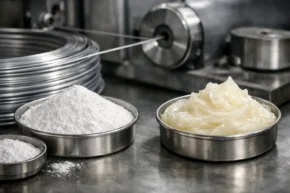
A wire line can meet diameter tolerance while quietly losing money through die wear, excess lubricant carryover, wire breaks, or inconsistent surface condition. The choice between sodium versus calcium wire drawing lubricants directly affects the boundary film between wire and die, particularly when reductions are demanding and production runs are long.
Neither soap system is universally better. Sodium- and calcium-based drawing compounds behave differently under pressure, heat, moisture, and surface-coating conditions. The right choice depends on the wire material, incoming coating, reduction schedule, drawing speed, die design, and downstream requirements.
Nutech Company has the expertise to select a lubricant that best fits your, material grades, in coming wire condition and post treatment demands. We offer a diverse line of sodium and calcium-based compounds formulated for a variety of wire drawing applications.
Why Soap Chemistry Matters in Wire Drawing
Dry wire drawing compounds commonly use metallic soaps to create a lubricating film on coated wire before it enters the die. That film must adhere to the wire, remain intact under high unit pressure, reduce metal-to-die friction, and release without creating unacceptable residue in subsequent operations.
Sodium and calcium soaps differ in water affinity, film character, melting behavior, and how they interact with common carrier coatings such as phosphate. Formulators can further adjust performance through fatty-acid selection, particle size, extreme-pressure additives, solid lubricants, fillers, and corrosion-control components. For that reason, the metal soap alone does not define performance, but it strongly influences the formulation’s operating range.
A useful evaluation begins with the condition at the die. A lubricant that looks effective in the box may still fail if it does not pick up evenly on the wire or if its film becomes unstable after several reductions.
Sodium Versus Calcium Wire Drawing Lubricants: Core Differences
Sodium-based soaps are generally more water-responsive than calcium soaps. This characteristic can support easier dispersion, more active lubricant pickup under certain conditions, and simpler cleanup where water-based removal is part of the process. In appropriate formulations, sodium soap compounds can produce a smooth drawing action and support good surface quality through moderate reductions.
Calcium-based soaps are generally less water-soluble and are often selected where a more persistent, pressure-resistant boundary film is needed. Their water resistance can be beneficial in demanding dry drawing conditions, especially when lubricant must remain on the wire through multiple dies and elevated contact temperatures.
Those broad differences should not be treated as fixed rules. A calcium formulation can be engineered for controlled pickup and cleanliness, while a sodium formulation may include additives that improve load-carrying capability. The practical question is not simply which metal soap is present. It is whether the complete compound maintains the correct film at the specific speed, reduction, and temperature of the line.
Sodium Soap Systems
Sodium soap drawing lubricants are often considered when a line needs a compound with responsive pickup and manageable residue removal. Their behavior may be advantageous for operations that have reliable surface preparation, controlled moisture, and reductions that do not demand the highest possible film strength.
Potential advantages include consistent coating interaction, good lubricity in suitable reduction schedules, and easier cleaning in some downstream processes. Potential limitations appear when die pressure, heat, or total reduction exceed the film’s capacity. Under those conditions, the lubricant may be consumed too quickly, causing friction to rise and die wear to accelerate.
Sodium systems also require attention to humidity and storage conditions. Because they can be more moisture-sensitive, changes in plant conditions may affect powder flow, pickup, and apparent lubrication performance. A process that runs well in a controlled trial should therefore be confirmed across normal seasonal operating conditions.
Calcium Soap Systems
Calcium soap drawing compounds are commonly used where the process calls for a durable dry film with strong resistance to squeeze-out. They can be a practical fit for heavier-gauge wire, higher reductions, multi-die drawing, or applications where die life and lubricant persistence are primary concerns.
A properly matched calcium system can reduce frictional heat, limit metal pickup on dies, and help maintain stable drawing forces. The resulting benefit is often more predictable operation rather than a single dramatic change in line speed. Reduced die polishing frequency, fewer breaks, and more consistent surface appearance can produce meaningful operating value over a full production campaign.
The trade-off is that a persistent film may also be more difficult to remove. If wire will be welded, plated, painted, annealed, or coated after drawing, residue compatibility must be assessed before approving the lubricant. A compound that protects the die exceptionally well may create downstream cleaning demand if it is not matched to the finishing sequence.
Match the Lubricant to the Entire Process
Wire drawing lubricant selection should begin with the full process route, not the drawing machine alone. Carbon steel, stainless steel, galvanized wire, and specialty alloys present different surface conditions and pressure demands. Incoming wire coatings matter just as much. Phosphate, borax, lime, and other carrier layers influence how the lubricant adheres and replenishes at the die interface.
Reduction per pass and total reduction are central decision points. Modest reductions may allow a sodium-based compound to operate effectively with clean results. As reductions increase, especially across several dies, a calcium-based system or a blended formulation may offer the film durability needed to control friction. High speeds increase the importance of thermal stability, since localized temperature at the die can be substantially higher than the bulk temperature measured around the machine.
Die material and geometry also affect results. Tungsten carbide and polycrystalline diamond dies respond differently to lubrication demands, while bearing length, approach angle, and die finish change how the film is formed and retained. Lubricant selection cannot compensate for worn or improperly specified dies, but it can help protect well-maintained tooling from premature wear.
Evaluate Performance Beyond Lubricant Consumption
The lowest lubricant usage rate is not always the lowest-cost result. An aggressive reduction in lubricant feed can reduce consumption per pound while increasing die temperature, drawing force, surface scoring, and wire breaks. The better measure is total operating cost per pound or per finished spool.
During a controlled comparison of sodium and calcium wire drawing lubricants, monitor drawing force or motor load, die temperature where practical, break frequency, die wear, powder carryover, wire surface condition, and downstream cleaning performance. Track these measures by wire grade, diameter, die sequence, and production shift. One averaged line result can hide variation that points to a setup issue or a formulation mismatch.
A disciplined trial should run long enough to capture normal changes in wire rod condition, operator practices, and lubricant-box replenishment. Short trials can favor a compound that performs well on freshly cleaned equipment but loses consistency as fines, heat, and carried-in material accumulate.
Control the Lubricant Box and Surface Preparation
Even a well-formulated compound will not deliver consistent results in a poorly controlled lubricant box. Lubricant depth, powder condition, wire path, wiper setup, box contamination, and replenishment practice all influence pickup. Excessive fines or foreign material can interrupt film formation and contribute to abrasive die wear.
Surface preparation deserves equal attention. Poorly formed or uneven conversion coatings create uneven lubricant retention. The result may be isolated high-friction zones that show up as erratic force, chatter marks, or premature wire breaks. When drawing performance changes suddenly, confirm the quality and weight of the incoming coating before changing lubricant chemistry.
Storage practices also matter. Keep dry compounds protected from moisture and contamination, use first-in, first-out inventory control, and avoid mixing remaining material with a new product unless the formulation supplier has confirmed compatibility. These basic controls help preserve the performance designed into the compound.
When a Blend or Custom Formulation Is the Better Answer
Some operations do not fit cleanly into a sodium-or-calcium decision. A blended soap system can balance pickup, lubricity, film persistence, cleanliness, and downstream removal. Additive packages may further improve high-pressure performance, reduce dusting, adjust flow properties, or support specific coating systems.
This is where application-specific formulation and technical service are valuable. Nutech Company can evaluate operating symptoms alongside wire material, coating chemistry, die schedule, and downstream requirements to identify a drawing compound designed for the actual production environment. The objective is not to force a standard lubricant into every line, but to establish a stable process with measurable value.
The best lubricant choice is the one that protects dies, supports consistent wire quality, and fits the complete manufacturing route. Start with the film required at the die, then verify the answer through controlled production data rather than assumptions about soap chemistry alone.