
A heat-treated part can leave the furnace with the required hardness and still create problems downstream. inconsistent color, flash rust, and handling stains can all undermine the value of an otherwise controlled heat-treatment cycle. Water soluble oil for blackening heat treated parts is often selected as a final-stage as a protective film when operations need a dark, uniform appearance without the heavy residue associated with straight oils or an additional hot black oxide step.
The right product is not simply an oil that mixes with water. It must fit the blackening method, alloy condition, rinse quality, corrosion-protection requirement, and the next manufacturing step. A fluid that looks acceptable on a sample panel may perform poorly on high-carbon steel, threaded assemblies, close-tolerance parts, or components stored in humid conditions.
Where Water-Soluble Oil Fits in the Blackening Process
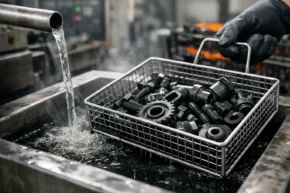
Parts are simply quenched into a 15-25% NuBlack 100 solution creating a uniform black/blue appearance and rust protection. Because the product is diluted and applied through a controlled tank immersion stage, it can be easier to manage than a heavier straight oil film.
What the Oil Must Do After Blackening
The most effective water-soluble sealing oil balances appearance, protection, and process compatibility. Film appearance is usually the first issue production teams notice. A suitable product should produce a consistent dark tone without rainbowing, blotchiness, heavy pooling, or a greasy feel that attracts dust.
Corrosion protection should be evaluated against the actual storage and shipment conditions, not assumed from the color of the part. Indoor components moving directly to assembly may need only a light, temporary film.
The residual film must also be compatible with downstream operations. If parts will be painted, powder coated, bonded, welded, plated, or assembled into fluid-sensitive systems, the sealant must either be easily removable or specifically approved for that next operation.
Key Selection Factors for Water Soluble Oil for Blackening Heat-Treated Parts
Heat-treated steel surfaces vary substantially. High-carbon and alloy steels may retain oxide, scale, or quench residues differently than low-carbon steels. Ground surfaces, machined threads, blind holes, and porous sintered components each hold solution differently. Parts with trapped moisture in recesses are particularly vulnerable to delayed staining and corrosion.
Start by defining the part family rather than selecting one chemistry for every blackened component. Consider steel grade, hardness range, surface finish, geometry, and temperature quenched from immediately after heat treatmen. The application concentration and drain time may need adjustment between open, simple parts and complex assemblies.
Application method and bath control
Immersion provides the most complete coverage, especially on threaded or irregular components. In either case, bath concentration, temperature quenched from, and dwell time affect the appearance.
Film thickness and drain characteristics
More concentration does not automatically mean better appearance. Too little concentration can produce a gray appearance and provide insufficient protection at edges and handling points.
The practical target is a continuous, controlled film. Evaluate parts after normal draining and drying conditions, not immediately after removal from the tank. This is especially important for parts with holes, pockets, and undercuts, where excess fluid can later bleed out and stain packaging.
Rust-protection window
Define protection in operational terms: hours on the plant floor, days before assembly, weeks in warehouse storage, or a specified shipping interval. Temperature swings, humidity, handling frequency, packaging material, and residual moisture all change the result.
Longer exposure may call for a dedicated rust preventative, vapor-corrosion-inhibiting packaging, lower-humidity storage, or a combination of these controls.
Process Issues That Commonly Affect Finish Quality
Uneven blackening is frequently blamed on the oil concentration and or quenching from temperature.
A milky or streaked finish can result from emulsion instability, incorrect concentration, excessive salt carryover, or hard-water contamination. Testing bath pH, concentration, and contamination level helps separate a chemistry issue from an operating issue. When a problem appears suddenly, compare current conditions with the last known acceptable batch rather than making several uncontrolled adjustments at once.
A Practical Qualification Approach
Before converting a production line, run representative parts through the entire sequence: cleaning, heat-treatment residue removal, blackening, rinsing, sealing, draining, drying, and packaging. Include the most difficult geometries and alloy conditions, not only flat test coupons.
Assess appearance after the parts have stabilized, then inspect after handling and after the planned storage period. Check for fingerprints, bleed-out, color consistency, corrosion at edges and recesses, and compatibility with the next process. If the line produces multiple part families, establish documented concentration and dwell-time windows rather than relying on operator judgment alone.
Nutech Company can support this type of application review by aligning water-soluble protective chemistry with the broader rust-preventative, and finishing sequence. That integrated view is valuable because a sealing oil is only one control point in the final part condition.
Operating Practices That Protect Results
Most importantly, qualify the finish against the real manufacturing path. The best final rust preventative oil is the one that produces the intended black appearance, survives the required handling and storage period, and leaves the part ready for its next operation.