
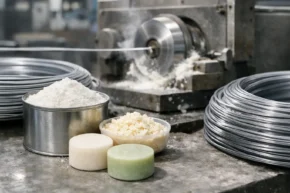
Wire drawing soaps are a primary process control variable, not a consumable to select on price alone. This guide to wire drawing soaps explains how dry lubricants influence die life, surface quality, drawing speed, cleanliness, and total operating cost across ferrous and nonferrous wire production.
In a dry drawing operation, the soap must do more than reduce friction. It must adhere to the incoming wire, enter the die consistently, withstand extreme pressure and heat at the reduction zone, and leave a lubricating film that supports the next pass. When any part of that system is out of balance, plants may see die scoring, wire breaks, uneven coating pickup, excessive dust, high drawing loads, or inconsistent finished dimensions.
What Wire Drawing Soaps Do
Wire drawing soaps are dry drawing compounds formulated from fatty acid salts, lubricity additives, extreme-pressure components, and, in some applications, solid lubricants or mineral fillers. They are commonly supplied as powders, flakes, granules, or pressed forms for use in soap boxes ahead of the drawing die.
As wire enters the soap box, the lubricant coats the wire surface and is carried into the die. Pressure and heat generated during reduction consolidate that material into a boundary film between the wire and die. A stable film lowers the coefficient of friction, controls drawing force, limits metal pickup on the die, and helps manage localized temperature.
The correct product depends on the wire material, coating condition, reduction schedule, die material, drawing speed, and downstream requirements. A soap that performs well for heavy carbon steel rod may not be appropriate for fine wire, stainless steel, galvanized wire, copper, aluminum, or a process with stringent cleaning and coating requirements.
Selecting Wire Drawing Soaps by Application
The first selection question is not simply whether the operation is drawing steel or nonferrous wire. The more useful question is what the lubricant must accomplish at the most demanding pass in the schedule.
Ferrous Wire Drawing
Carbon and alloy steel drawing often involves high contact pressure, elevated die temperatures, and significant total reductions. Sodium- and calcium-based soaps are widely used, with formulations tailored for low-carbon wire, medium- and high-carbon grades, tire cord, spring wire, welding wire, and other demanding products.
For heavier reductions or difficult steel grades, the soap may require greater film strength and extreme-pressure performance. The trade-off is that higher-performance compounds can leave more residual material, create additional cleaning demand, or require more careful soap-box control. For operations with downstream annealing, coating, welding, or plating, residue compatibility must be evaluated as part of the selection process.
Pickled and phosphated steel rod requires a different approach from mechanically descaled rod. A phosphate conversion coating can act as a carrier for the drawing soap, improving lubricant retention and supporting more demanding reductions. If phosphate coating weight or crystal structure changes, drawing performance can change even when the soap formulation remains the same.
Nonferrous Wire Drawing
Copper, aluminum, brass, and other nonferrous metals can require cleaner-running compounds with controlled residue characteristics. Surface appearance may be especially important where wire is used for electrical, architectural, or decorative applications.
Nonferrous operations often balance lubricity against cleanliness. A compound with aggressive boundary lubrication may reduce force but leave a film that interferes with annealing, electrical conductivity requirements, insulation application, or subsequent finishing. The right approach is to evaluate drawing performance and downstream cleanliness together rather than optimizing one stage at the expense of another.
Fine Wire and Multi-Die Machines
Fine-wire drawing magnifies inconsistency. Small changes in soap pickup, die condition, incoming wire cleanliness, or tension can lead to breaks and diameter variation. Compounds for these applications must feed predictably, resist packing in the soap box, and maintain film continuity through repeated reductions.
Multi-die machines also require attention to pass-by-pass lubricant demand. The first pass may need a compound that establishes strong coverage on incoming rod, while later passes may require lower residue, controlled drag, or a different formulation. In some cases, using one soap throughout the machine is appropriate. In others, a staged lubrication strategy provides better stability.
How to Evaluate a Soap in Production
A controlled trial should measure more than lubricant consumption. Production teams should compare drawing load, die life, wire breaks, speed capability, surface condition, residual soap, and downstream processing results. Procurement cost matters, but it is only one part of the cost equation.
Start with a defined baseline. Document the existing compound, soap-box fill condition, wire grade, coating condition, die geometry, reductions, line speed, and known defect rate. Without that information, a change in wire quality or die condition can be mistaken for a lubricant result.
Run the evaluation long enough to account for normal variation in incoming rod and die wear. Short trials can favor a product that initially feels smooth but does not maintain film performance over extended production. Review results with operators and maintenance personnel as well as engineering staff. Operators often identify practical concerns, such as poor flow, dusting, bridging, or difficult cleanup, before those issues appear in process data.
Application Control Matters as Much as Chemistry
A high-quality wire drawing soap cannot compensate for an improperly maintained soap box or poor wire preparation. The lubricant must be presented to the wire in a condition that allows uniform pickup.
Keep soap boxes clean and filled to the intended operating level. An underfilled box can reduce contact between wire and lubricant, while excessive compaction can prevent consistent flow. Contamination from scale, metal fines, water, oil, or incompatible compounds can alter the soap’s behavior and increase die wear.
Incoming wire condition is equally important. Residual acid, inconsistent phosphate, excess moisture, loose scale, or oil carryover can prevent the soap from adhering correctly. When drawing performance declines suddenly, inspect wire preparation before assuming the soap formula is at fault.
Die alignment and condition also affect lubricant demand. A worn, scratched, oversized, or misaligned die creates uneven pressure and localized heat. The soap may appear to fail, but the root cause may be die geometry or mechanical setup. Tracking die life by wire grade and reduction schedule helps separate lubricant issues from tooling issues.
Common Problems and Their Likely Causes
High drawing force generally points to insufficient film strength, poor soap pickup, inadequate carrier coating, excessive reduction, or a worn die. Before changing products, verify that the soap box is functioning, the incoming surface is consistent, and the die is within specification.
Frequent wire breaks can result from high friction, but they may also indicate material defects, tension instability, poor die alignment, or an aggressive reduction schedule. Examine break locations and surface condition. Breaks that occur repeatedly at the same die provide a more useful diagnostic signal than total break counts alone.
Die scoring or metal pickup may indicate that the compound lacks sufficient boundary lubrication for the application, especially at higher speeds or on difficult grades. It can also be caused by abrasive scale, poor descaling, or contamination in the lubricant box. A soap change without correcting abrasive contamination will rarely provide a durable improvement.
Excessive residue, dust, or soap buildup suggests that the product may be mismatched to the process, over-applied, or contaminated with fines. It may also point to a downstream cleaning process that is not matched to the lubricant chemistry. Consider the entire manufacturing route, including cleaning, heat treatment, coating, and packaging.
Working With a Technical Lubricant Supplier
The most productive supplier relationship begins with process information. A technical recommendation should account for wire chemistry, diameter range, incoming surface treatment, reduction schedule, die material, machine configuration, speed, and downstream requirements. Samples alone are not enough to establish the best product for a demanding line.
Nutech Company supports industrial metalworking operations with wire-drawing compounds and related process chemistry, including cleaners, conversion coatings, rust preventatives, and specialty lubricants. This broader capability is valuable when a drawing problem involves more than the soap box. Wire preparation, carrier coating, cleaning effectiveness, and corrosion protection can all influence drawing performance and finished-product quality.
The best wire drawing soap is the one that provides controlled friction, stable throughput, acceptable cleanliness, and predictable die life under actual production conditions. Treat lubricant selection as a process decision, measure results across the full manufacturing route, and involve technical support early when conditions change. That approach produces more reliable improvements than changing compounds only after defects reach the production floor.