
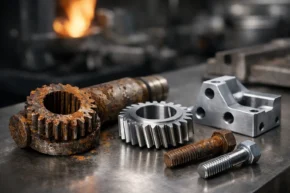
A part can leave a machining center with an excellent finish and still develop corrosion before it reaches assembly. Effective corrosion control on machined and heat treated parts begins well before final packaging. It depends on managing residual metalworking fluid, cleaner carryover, surface condition, humidity exposure, handling practices, and the compatibility of each protective chemical with downstream operations.
For manufacturers, corrosion is not simply an appearance issue. Oxide staining can cause dimensional concerns, interfere with coating adhesion, contaminate assemblies, increase rework, and create avoidable customer rejects. The most reliable approach treats corrosion protection as a controlled process that connects machining, cleaning, heat treatment, storage, and shipment.
Corrosion Control on Machined and Heat-Treated Parts Starts Before Storage
Many corrosion problems are blamed on storage conditions because parts rust while sitting in a rack, tote, or warehouse. In practice, the initiating condition often occurred earlier. Chips, salts, alkaline cleaner residue, fingerprints, hard-water deposits, and depleted metalworking fluids can all leave a surface more reactive than expected.
Freshly machined steel is particularly vulnerable. Machining exposes clean base metal while generating heat and increasing surface area at microscopic peaks and tool marks. A water-miscible coolant may provide short-term in-process protection, but its corrosion-inhibiting package is not designed to protect finished parts through extended in-plant storage or transportation.
Heat-treated parts present a different set of variables. Quench oils, polymer quenchants, salt residues, furnace atmosphere effects, and post-heat-treat cleaning can alter the surface chemistry. Tempering, washing, or grinding after heat treatment may remove existing protection and expose a new active surface. Protection should therefore be evaluated after the final operation that changes the part surface, not only after the first machining step.
Identify the Conditions Driving Corrosion
Corrosion control improves when the plant identifies the actual exposure mechanism instead of applying more rust preventive by default. Humidity is a common factor, but it is rarely the only factor. Condensation during temperature swings, wet parts loaded into closed containers, poor drainage, and contact between dissimilar metals can create localized attack even in facilities with reasonable ambient conditions.
Residual contamination is often the deciding factor. A part that appears clean may retain chloride, sulfate, cleaner alkalinity, or evaporated coolant solids in threads, blind holes, under burrs, or on rough machined surfaces. These deposits attract moisture and can concentrate corrosive ions. If corrosion begins repeatedly in the same feature, the issue may be drainage or cleaning coverage rather than the selected rust preventative.
Handling also matters. Bare-hand contact deposits moisture, salts, and oils on active metal surfaces. Parts moved from a cool area into warm, humid air can form condensation almost immediately. When production schedules require parts to wait between operations, the protection plan must account for those actual hold times and environmental transitions.
Build Protection Into Each Process Stage
The most effective systems use several compatible controls rather than relying on one final coating. Metalworking fluids should provide appropriate in-process rust protection while maintaining machining performance and fluid stability. Parts should then be cleaned thoroughly enough to remove residues that would compromise later treatment, while avoiding cleaner chemistry that leaves corrosion-promoting salts or insufficient rinse quality.
After cleaning, parts must dry completely and promptly. Water trapped in internal passages, threaded features, crevices, and stacked-part contact points can defeat a quality rust preventive. Forced air, heated drying, vacuum drying, or controlled dwell time may be necessary depending on geometry and production volume. The goal is not merely to make the surface look dry. It is to remove retained moisture where corrosion begins.
A practical process review should confirm five conditions:
- The metalworking fluid delivers suitable interim corrosion protection at the concentration used on the floor.
- Cleaner concentration, temperature, and dwell time remove soils without leaving objectionable residue.
- Rinse water quality and conductivity are controlled where water spotting or salt carryover is a risk.
- Parts are dried effectively before applying a rust preventive or loading them into packaging.
- The selected protective film remains effective through the expected storage, handling, and transportation period.
Each condition influences the next. For example, increasing cleaner concentration may improve soil removal but create a greater rinsing burden. A heavier rust preventive may extend protection but interfere with gauging, assembly, welding, painting, or adhesive bonding. The correct solution is application-specific.
Select Rust Preventatives for the Actual Exposure
Rust preventatives are not interchangeable. Selection should be based on part material, surface condition, application method, drying requirement, storage duration, packaging, and downstream processing. A light solvent-deposited film may be appropriate for short-term indoor protection of machined components that will be assembled soon. A more substantial water-displacing or long-term protective coating may be needed for parts exposed to humid storage, overseas shipment, or extended inventory cycles.
Film characteristics matter. Some applications require a thin, nearly imperceptible film that will not affect tolerances or handling. Others benefit from a heavier, waxy, oily, or removable barrier. If the part will be painted, plated, phosphated, welded, or bonded, the plant must confirm removability and compatibility with the next process. A coating that provides excellent corrosion resistance but causes downstream defects is not a successful control.
Application coverage is equally important. Dip, spray, flow coat, and immersion methods each have strengths. Dipping can provide reliable coverage on complex geometries but may carry excess product into cavities. Spraying can reduce consumption and support automation but may miss shadowed areas if nozzle position and part orientation are not controlled. Where internal features are critical, process engineers should verify that the rust preventive reaches and drains from those areas consistently.
Heat Treatment Requires Its Own Corrosion Strategy
Heat treatment can change both the corrosion behavior of the part and the protection requirements that follow. Scale, discoloration, decarburization, and residual quench media may require cleaning before a protective film can perform properly. Parts that are ground after heat treatment become especially active because the grinding operation exposes fresh metal and may leave moisture or grinding-fluid residues on the surface.
Quench oils and polymer quenchants should be evaluated for their impact on post-process cleaning and short-term protection. A quench medium that is difficult to remove can create downstream coating issues. Conversely, aggressive cleaning may strip all residual protection from a part that will wait before its next operation. The sequence should be designed around the real production route, including weekend holds, off-site processing, and shipment timing.
Furnace atmosphere and post-heat-treat handling deserve attention as well. Parts leaving a furnace may enter a temperature and humidity range where condensation becomes likely. If they are placed into dense containers while still warm, trapped moisture can create corrosion in contact areas that are not visible until the parts are separated. Cooling, drying, and packaging procedures should be defined for the specific part geometry and load configuration.
Validate Protection With Plant-Specific Testing
Standard corrosion tests can provide useful comparative data, but they do not replace process validation under actual manufacturing conditions. Salt spray testing may help rank coatings, yet it can overemphasize certain failure modes that do not reflect indoor storage. Humidity cabinet testing, cyclic corrosion testing, water-displacement checks, and controlled warehouse exposure may provide more relevant information depending on the application.
Production trials should include the full sequence: machining or grinding, cleaning, rinsing, drying, rust-preventive application, packaging, storage, and any downstream removal process. Inspect the features most likely to fail, including threads, bores, sharp edges, ground surfaces, stacked contact points, and areas under labels or packaging materials.
Record more than pass-or-fail results. Note film weight or concentration, application temperature, drainage time, fluid condition, rinse-water quality, package type, humidity, and storage duration. This information makes it possible to distinguish a chemistry issue from a process-control issue. It also gives maintenance and production teams a defined standard when conditions change.
Treat Packaging and Logistics as Protective Controls
A correctly treated part can still rust in unsuitable packaging. Wet wood, contaminated corrugated material, non-volatile packaging oils, and unsealed containers can introduce moisture or allow humidity to reach the parts. VCI materials may be effective when selected and used correctly, but they work best with clean, dry parts and an enclosure that can maintain the intended vapor environment.
Avoid packing parts while they are wet or while protective films have not drained or dried as intended. Dense stacking can trap moisture and prevent vapor-phase protection from reaching inner surfaces. For long-distance shipments, consider expected temperature cycles, transit time, port delays, and the possibility of containers sitting in humid environments.
Nutech Company can help manufacturers evaluate the interaction between metalworking fluids, cleaners, heat-treating chemicals, conversion coatings, and rust preventatives as one process rather than separate purchasing categories. The practical objective is consistent protection that supports part quality without adding unnecessary cost or disruption to production.
The best corrosion program is one operators can run consistently: clean parts, controlled rinsing and drying, correctly applied protection, and packaging that matches the actual journey from machine to customer.