
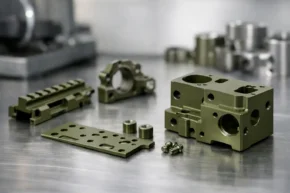
NUTECH ANODYE OD Green is a dye mixture that produces a military olive drab shade often specified as MIL 595 34089. Unlike other olive drab dyes, this blend has been specially formulated to consistently hold color over the life of the bath. NUTECH ANODYE BLACK 100 is a light fast and weather fast dye that can be used to color aluminum to be used for both out-door and in-door applications. It is also suitable for producing dark green colors and for shading. For aluminum coloring MIL 595 34089, success depends on more than selecting a green paint code. The aluminum condition, pretreatment, coating chemistry, gloss level, cure profile, and inspection method all affect whether production parts deliver a repeatable visual match and the required service life.
MIL 595 34089 is commonly used as shorthand for a government color requirement. In production documentation, the applicable color standard and revision must be verified before material is ordered or parts are processed. The color designation identifies the target appearance. It does not, by itself, define the coating type, film thickness, pretreatment, corrosion resistance, adhesion requirement, or exposure conditions.
What MIL 595 34089 Actually Controls
Color 34089 is a flat green color designation associated with the federal color system used in government procurement. The first digit identifies a flat finish category, while the color family and specific chip are identified by the remaining digits. A current, controlled physical color standard should be the final reference for approval.
This distinction matters because a color chip is not a complete finishing specification. A customer may call out 34089 while separately requiring a powder coating, liquid coating, anodic coating, chemical conversion coating, or a specific military or aerospace coating system. They may also require salt spray performance, solvent resistance, flexibility, abrasion resistance, infrared characteristics, or limits on volatile organic compounds.
Electronic color values, monitor images, and formula databases are useful for initial development, but they are not substitutes for the physical standard. Screen calibration, lighting, pigment selection, film build, and surface texture can all shift the perceived result. A formula that matches a digital target can still miss the approved chip when viewed under controlled lighting.
Aluminum Coloring MIL 595 34089 Begins With the Substrate
Aluminum is not one uniform surface. Castings, extrusions, sheet, machined components, and fabricated assemblies each present different finishing conditions. Alloy chemistry, porosity, machining lubricants, oxide formation, weld discoloration, handling soils, and surface roughness can change coating appearance and adhesion.
Cleaning is the first production control point. Residual cutting fluids, stamping lubricants, buffing compounds, fingerprints, or shop contamination can cause craters, poor wetting, blisters, and adhesion failures. The cleaner must remove soils without attacking the substrate or leaving residues that interfere with subsequent treatment.
After cleaning, aluminum typically needs a conversion treatment or another compatible pretreatment before an organic coating is applied. Conventional chromate conversion coatings have long been used where demanding corrosion protection and paint adhesion are required. Non-chrome conversion coatings are also widely specified where process, environmental, and customer requirements support their use. The appropriate choice depends on the part’s exposure, coating system, customer specification, and operating controls.
Pretreatment quality has a direct effect on final color consistency. Uneven conversion coating weight, water-break failures, incomplete rinsing, and excessive drying temperatures can create visible variation under a thin flat coating. When color is critical, the finishing process should treat pretreatment as part of color control, not merely as a corrosion-control step.
Select the Coating System for Both Color and Service
A flat MIL 595 34089 appearance can be achieved with different coating technologies, but those technologies do not perform the same way in service. Liquid coatings can be effective for complex geometries, touch-up work, low-volume parts, and applications where a specific approved formula is required. Powder coatings can provide efficient coverage and durable films on suitable parts, but film build and texture must be controlled carefully to maintain the required flat appearance.
Anodizing may be considered for some aluminum components, particularly where a metallic substrate appearance, dimensional control, or wear performance is needed. However, anodized color is not automatically interchangeable with an opaque painted color standard. Alloy variation, anodic film thickness, dye behavior, sealing, and substrate finish can create lot-to-lot appearance changes.
The coating supplier and finishing operation should agree on the critical requirements before production begins. At minimum, those requirements should address the approved color standard, target gloss, substrate preparation, dry-film thickness, cure schedule, masking needs, test panels, and acceptance criteria. If parts will be exposed outdoors, used near chemicals, assembled with dissimilar metals, or stored in humid conditions, those conditions should be included in the system selection.
Flat finishes require particular attention. A flatting agent reduces gloss, but it can also affect flow, hiding, durability, cleanability, and color development. Too much film build can alter sheen and make corners look darker. Too little coverage can allow the substrate or pretreatment variation to influence the final appearance. The target is not simply “green paint.” It is a controlled finish that looks consistent across the entire production lot.
Control Application Variables That Shift Color
Even an approved coating formula can produce inconsistent parts when process variables drift. Spray equipment condition, atomization, fluid pressure, electrostatic settings, booth airflow, grounding, humidity, and operator technique all affect deposition and appearance. Powder application has additional sensitivity to powder charge, reclaim management, gun settings, and part geometry.
Cure must be verified by part metal temperature, not oven air temperature alone. Heavy castings, thin sheet components, mixed-load racks, and crowded ovens do not heat at the same rate. Under-cure can reduce adhesion, solvent resistance, and corrosion performance. Over-cure can shift color, change gloss, embrittle some systems, or degrade the coating’s intended properties.
Production teams should establish a repeatable work instruction with approved windows for film thickness and cure. For parts with recessed areas, sharp edges, fastener holes, or welded joints, trial panels and first-article parts are preferable to assumptions. These locations are often where coverage, corrosion protection, and visual consistency become difficult.
Inspect the Finish Under Defined Conditions
Visual inspection remains essential for a color requirement such as 34089. Compare the coated part to the controlled standard under the lighting conditions defined by the customer or internal quality procedure. Daylight-equivalent lighting is commonly used because it reveals color differences that may be hidden under warm shop lighting.
Instrumental color measurement can improve process control, especially for recurring high-volume work. A spectrophotometer can trend color variation and identify drift before it becomes a rejection issue. However, the measurement geometry, calibration routine, sample orientation, gloss level, and texture must be consistent. Flat coatings and textured surfaces can produce readings that do not fully represent what an inspector sees.
A practical inspection plan usually combines visual comparison with measurable process checks. This includes dry-film thickness, gloss measurement where applicable, cure verification, adhesion testing, and corrosion testing when the specification requires it. Record the coating batch, pretreatment lot, application date, oven profile, and inspection results. That traceability makes it possible to isolate a process change when a color or performance issue occurs.
Common Causes of 34089 Color Rejections
Most color rejections are traceable to a small number of controllable issues. Using an outdated chip or an unverified digital reference can establish the wrong target before production starts. Substituting a coating based only on a similar color name may create an unacceptable hue or gloss difference.
Other frequent causes include inconsistent cleaning, variation in conversion coating quality, film thickness outside the approved range, incomplete mixing of flatting components, improper reduction of liquid coatings, and cure profiles that do not match the coating manufacturer’s requirements. Rework can create further variation because a second coat often changes hiding, texture, and sheen.
The most effective response is to qualify the complete process rather than qualifying paint in isolation. Run representative aluminum parts through the actual cleaning, pretreatment, application, and cure sequence. Retain approved panels and first-article samples for direct comparison. When the same process must support multiple alloys or part geometries, determine whether each requires its own validated parameters.
For manufacturers managing color-critical aluminum components, technical support should extend beyond coating selection. Nutech Company can help evaluate the cleaning, pretreatment, and process-control requirements that support dependable finishing performance. A color standard is only as reliable as the production system built around it, and disciplined process control keeps approved parts moving without avoidable rework or inspection delays.