
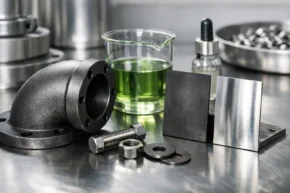
Stainless steel is selected for corrosion resistance, but its chromium-rich passive surface can make cold-forming lubrication difficult to control. Oxalate coating and post treatments for stainless steel are used when a production line needs a tightly bonded carrier layer that improves lubricant retention, reduces die pickup, and supports consistent drawing or forming performance. Nutech Company offers coatings and post treatments for drawing and extruding stainless steel.
The process is not a general-purpose corrosion-protection treatment. It is a controlled conversion-coating system whose value depends on the stainless grade, incoming surface condition, part geometry, forming severity, and the lubricant or soap applied after coating. When those elements are aligned, an oxalate system can reduce friction-related defects and improve repeatability through demanding metalworking operations.
Where Oxalate Coatings Fit in Stainless Steel Processing
Oxalate conversion coatings are most often considered for stainless wire drawing, tube drawing, cold heading, and severe forming operations. The coating creates a fine crystalline surface that can hold a compatible lubricant more effectively than untreated stainless steel. That retained lubricant becomes the working interface between the part and the die, mandrel, tooling, or forming equipment.
This is particularly useful where stainless steel’s work-hardening tendency, surface galling risk, and high forming loads challenge conventional lubricants. A properly prepared oxalate coating can help distribute the lubricant film and reduce direct metal-to-metal contact. The operational objective is not merely a coated appearance. It is stable friction control from the first production piece through the end of a run.
Oxalate coatings should not be confused with passivation. Passivation is intended to remove free iron and support the natural chromium oxide film that provides stainless steel’s corrosion resistance. An oxalate treatment is applied primarily to support a subsequent manufacturing operation. Depending on the final product requirements, the oxalate layer may be removed after forming, followed by cleaning and, where appropriate, passivation.
Surface Preparation Determines Coating Quality
The conversion layer can only be as consistent as the surface entering the coating tank. Oils, drawing compounds, heat-treat scale, oxide films, shop soil, and residual cleaner chemistry can cause incomplete coating coverage or uneven crystal formation. Those defects often appear later as lubricant skip, variable draw loads, die scoring, or localized galling.
A typical process begins with cleaning that is matched to the incoming contamination. Alkaline cleaning may be effective for machining oils and light soils, while more difficult residues may require a stronger cleaning sequence. Rinsing between stages is essential. Cleaner carryover can alter the oxalate bath and shorten useful bath life.
For stainless steel, activation or pickling may be necessary to provide a chemically receptive surface. The correct approach depends on alloy family, scale condition, and the degree of surface work already present. Austenitic, ferritic, martensitic, and precipitation-hardening grades do not always respond identically. Highly polished material, heavily work-hardened stock, and heat-affected surfaces may also require different preparation controls.
A supplier’s technical recommendation should account for the full line, not only the coating tank. Water quality, rinse configuration, dwell time, bath temperature, agitation, and drag-out control all affect coating weight and uniformity. A conversion coating that looks acceptable in a lab sample may not perform in production if pretreatment varies by shift or incoming material lot.
Controlling the Oxalate Conversion Stage
The oxalate stage is designed to develop an adherent, fine-grained coating without excessive buildup. Too little coating may provide limited lubricant anchoring. Too much coating can become powdery, create inconsistent dimensions, or break down under deformation. The acceptable coating range is application-specific and should be established through production trials rather than assumed from a generic specification.
Bath chemistry must be monitored for concentration, acidity, dissolved metal accumulation, contamination, and operating temperature. These conditions influence coating rate, crystal structure, and coverage. In continuous wire or tube operations, high throughput can create significant drag-out and bath loading, making replenishment discipline especially important.
Line speed and immersion time require the same attention. An underexposed surface may not develop sufficient conversion coating, while extended exposure can produce a heavier layer that does not match the intended lubricant system. Routine checks of coated weight, surface appearance, and downstream draw performance provide better process feedback than visual inspection alone.
The target is a coating that remains bonded through handling and carries the selected lubricant into the deformation zone. A brittle or poorly adherent layer can contaminate dies and equipment, creating maintenance problems rather than solving them.
Post Treatments for Lubricant Retention and Handling
Post treatment begins immediately after the conversion stage. Controlled rinsing removes residual bath chemistry without stripping or damaging the newly formed coating. Counterflow rinses, appropriate rinse-water quality, and regular control of conductivity help limit contamination transfer to subsequent stages.
The next step is usually selected according to the metalworking process. In many drawing applications, the coated stainless steel receives a soap or lubricant treatment designed to bond with the oxalate surface. Dry soap systems can provide a durable carrier for high-load drawing, while reactive or polymer-based treatments may be used where handling, cleanliness, or specific forming conditions require a different lubricant profile.
For operations with very high reduction rates or difficult geometry, the post-treatment system may include a pre-lube followed by a drawing lubricant. The chemistry must be evaluated as a package. A high-performing oxalate coating paired with an incompatible soap can still result in high draw loads, heat buildup, or die wear.
Drying is another process control point. Parts should be dried thoroughly enough to prevent water from diluting or disrupting the lubricant film, but excessive temperatures can affect certain lubricant systems or leave undesirable residues. Consistent drying also improves handling and reduces the risk of staining during staging or storage.
Where corrosion protection is needed between process steps, a compatible temporary rust inhibitor may be appropriate. However, stainless steel’s expected storage environment and later finishing requirements must be considered. A protective film that helps short-term handling may create cleaning challenges before welding, coating, plating, or passivation.
Selecting a System by Operation, Not by Alloy Alone
Stainless alloy is a starting point, not the only selection criterion. A 304 wire drawn through multiple dies has different coating and lubricant requirements than a 410 component being cold formed, or a precision tube requiring a clean internal surface. Reduction percentage, die material, surface finish requirements, intermediate annealing, and final cleaning standards all affect the best system.
For example, a heavy wire-drawing operation may prioritize strong soap pickup, low drawing force, and reduced die wear. A formed component intended for medical, food-processing, or architectural service may place greater emphasis on complete residue removal and a final passivation sequence. In that case, the process must be designed so the lubricant carrier does not interfere with final surface qualification.
Quality checks should reflect the actual failure modes of the line. Useful controls may include coating weight, lubricant pickup, draw force trends, die inspection, surface roughness, residue evaluation after cleaning, and corrosion testing when the final part specification requires it. Tracking only bath titration can miss downstream issues caused by inadequate rinsing, variable incoming material, or lubricant contamination.
Common Problems and Practical Corrections
Patchy coating commonly points to insufficient cleaning, incomplete activation, oxide scale, or poor rinse control. Before increasing coating time or bath strength, confirm that the substrate is entering the conversion stage uniformly clean and receptive.
Poor lubricant adhesion can result from a light or poorly formed conversion layer, but it can also indicate that the lubricant chemistry is not compatible with the coating. Review coating characteristics and post-treatment pickup together. A change in soap concentration, drying conditions, or application method can be as significant as a bath adjustment.
High draw loads and galling may indicate inadequate lubricant film, excessive reduction per pass, die condition issues, or coating breakdown under load. Chemical adjustments should be evaluated alongside mechanical factors. A conversion coating cannot compensate for damaged dies, misalignment, or a reduction schedule beyond the material’s practical forming window.
Residue remaining after final cleaning is another frequent concern. This often requires revisiting the full sequence, including the choice of post lubricant, cleaning chemistry, water temperature, mechanical action, and rinse effectiveness. The correct answer is not always a more aggressive cleaner, particularly where surface finish or dimensional tolerance must be protected.
Building a Repeatable Production Process
A reliable oxalate line is managed as an integrated metalworking system: incoming material preparation, conversion chemistry, rinse control, lubricant application, drying, forming, and final cleaning. Changes in one stage can shift performance elsewhere. That is why trial work should use production-representative material, tooling, reductions, and line speeds.
Nutech Company, LLC supports manufacturers with specialty chemical formulations and technical service focused on the interaction between conversion coatings, drawing compounds, cleaners, and corrosion-control requirements. The practical goal is measurable operating value: stable production, cleaner tooling, fewer friction-related defects, and a process that fits the final part specification.
Before committing to an oxalate system, define the result the operation must achieve at the die and after the final clean. That discipline leads to a treatment sequence built for the actual production line, not a coating selected in isolation.