
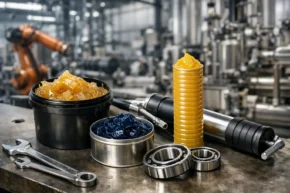
A failed bearing rarely points to one cause. The grease may have softened under heat, washed out during cleanup, separated in storage, or lacked the base oil viscosity needed to maintain a film under load. This industrial grease selection guide focuses on the operating conditions that determine whether a grease will protect equipment or become a recurring maintenance problem.
Grease is not simply oil made thicker. It is a lubricating system made from base oil, a thickener, and performance additives. Each component affects how the product handles temperature, speed, load, water, corrosion, and relubrication intervals. Selecting by color, brand familiarity, or NLGI grade alone can lead to premature bearing wear, excess grease consumption, and unplanned downtime.
Start With the Application, Not the Grease Name
The first question is what component needs lubrication and what conditions it actually sees in production. A grease used in a slow-moving, heavily loaded press bearing faces a different demand than one used in a high-speed electric motor, conveyor idler, kiln support, or washdown-area bearing. Nutech Company has grease to meet every lubrication application. From the most demanding steel mill grease containing solid film molybdenum disulfide for high-performance where there’s extreme heat and pressure to common bearing grease.
Document the equipment type, bearing design, load direction and severity, operating speed, ambient temperature, bearing temperature, exposure to water or process chemicals, and relubrication method. Also account for the material being processed. Metalworking operations may introduce coolant mist, fines, scale, cleaning residues, or corrosive contaminants that affect grease life.
Duty cycle matters as much as nominal operating conditions. A bearing that runs at moderate speed continuously may generate more heat than a bearing that sees higher speed for short intervals. Similarly, shock loading from stamping, forging, or material handling can demand a stronger lubricating film even when the bearing operates at low speed.
Select Base Oil Viscosity for Speed and Load
Base oil viscosity is one of the most consequential grease properties. It determines the oil film available at the lubricated contact. In general, slower and more heavily loaded equipment requires higher-viscosity base oil. High-speed bearings commonly require lower-viscosity base oil to limit churning, friction, and temperature rise.
A grease with an NLGI Grade 2 consistency can contain very different base oils. Two products with the same consistency may therefore perform very differently in the same bearing. The NLGI grade describes grease firmness, not the base oil viscosity or its ability to carry load.
Mineral oil remains a practical base oil choice for many general industrial applications. Synthetic base oils may be appropriate where temperature extremes, extended service intervals, oxidation resistance, or low-temperature pumpability justify the added cost. The correct choice depends on the equipment requirement and the economic impact of downtime, not on the assumption that synthetic grease is automatically better.
For high-speed applications, confirm the bearing manufacturer’s speed factor guidance and grease fill recommendation. Overly viscous grease or excessive fill can raise operating temperature, accelerate oxidation, and force grease out of seals. For low-speed, heavily loaded applications, a low-viscosity grease may allow metal-to-metal contact despite an otherwise suitable additive package.
Match the Thickener to Temperature and Environment
The thickener holds oil in place and influences mechanical stability, water resistance, pumpability, and high-temperature behavior. Common thickener systems include lithium, lithium complex, calcium sulfonate complex, aluminum complex, polyurea, and clay-based formulations. Each has operating advantages and limitations.
Lithium complex greases are widely used in industrial facilities because they can offer balanced performance across general bearing and chassis-type applications. Calcium sulfonate complex products are often selected where high load capacity, corrosion resistance, and water resistance are priorities. Polyurea greases are frequently used in electric motor bearings, but compatibility must be evaluated carefully when changing from another grease type.
High temperature does not mean one thing. Consider both the normal bearing temperature and short-duration peaks. A grease may tolerate a stated temperature range but still oxidize quickly if it operates near its upper limit for extended periods. Grease life declines sharply as operating temperature rises, and a high-temperature thickener cannot compensate for inadequate oxidation stability or an unsuitable base oil.
Water exposure also requires specificity. Splashing water, steam, direct washdown, and water-based process fluids affect grease differently. In wet environments, look beyond a general water-resistant claim. Evaluate water washout resistance, corrosion protection, mechanical stability after water exposure, and the ability to maintain consistency over the intended relubrication interval.
Use NLGI Grade for Delivery and Retention
NLGI consistency grade helps determine whether grease can be delivered to the lubrication point and remain where it belongs. Grade 2 is common for manually greased bearings and many centralized systems. Grade 1 or Grade 0 may be needed where low-temperature pumpability or long distribution lines create higher resistance. Stiffer grades can be useful where leakage control and retention are primary concerns, provided the grease can still move through the system and enter the bearing.
Do not treat a firmer grease as a heavier-duty grease. A high NLGI grade may reduce flow to critical lubrication points, particularly in automatic systems or cold plant conditions. Conversely, grease that is too soft may leak through seals, migrate away from the contact zone, or separate under mechanical working.
Check the actual delivery path. Reservoir design, line length, pipe diameter, metering valves, fittings, ambient temperature, and cycling frequency all influence whether a grease reaches the bearing consistently. A grease selection that works in a hand gun may fail in a centralized lubrication system.
Specify Additives for the Actual Failure Risk
Additives should address identifiable application demands. Extreme-pressure and anti-wear additives can help protect heavily loaded contacts, shock-loaded bearings, and certain sliding surfaces. Rust and oxidation inhibitors support protection during humid shutdowns and extended operating periods. Tackifiers can improve adhesion in exposed applications, while solid lubricants may be useful for selected low-speed, high-load conditions.
There are trade-offs. Some additive chemistries may not be appropriate for every bearing material, speed, temperature, or process environment. Solid additives, for example, can be beneficial in slow, heavily loaded equipment but may not suit high-speed precision bearings. Food-processing, clean manufacturing, or sensitive finishing operations may also require formulations that meet specific incidental-contact or cleanliness requirements.
If bearing failure analysis shows corrosion, fretting, false brinelling, electrical damage, or contamination ingress, do not assume an EP grease is the solution. Those mechanisms require different corrective actions that may involve sealing, storage procedures, vibration control, grounding, lubricant type, or relubrication practices.
Manage Grease Compatibility During Product Changes
Mixing greases is a common source of avoidable trouble. Thickener systems can be incompatible, causing softening, hardening, oil separation, reduced heat resistance, or poor mechanical stability. Even greases with similar thickener types can vary in base oil, additive chemistry, and intended service conditions.
Before changing products, review supplier compatibility guidance and assess the existing grease in the equipment. When compatibility is uncertain, purge the old grease thoroughly during the conversion. For critical equipment, use a controlled changeover plan that identifies the old product, new product, lubrication points, purge quantity, initial inspection interval, and temperature monitoring requirements.
Compatibility is not limited to grease-to-grease mixing. Confirm compatibility with seals, paints, plastics, and nearby process chemicals. In metalworking facilities, accidental contact with coolants, cleaners, rust inhibitors, or particulate contamination can affect grease performance and should be considered during root-cause review.
Set Relubrication Intervals With Operating Evidence
More grease is not always better. Overgreasing can churn lubricant, raise bearing temperature, damage seals, and push grease into finished products or work areas. Undergreasing increases the risk of film loss, contamination damage, and accelerated wear.
Set initial relubrication intervals using bearing size, speed, temperature, load, contamination, and equipment manufacturer guidance. Then refine the interval with operating evidence. Bearing temperature trends, ultrasound, vibration data, grease appearance, purge condition, and maintenance history provide more useful direction than a fixed calendar schedule applied across the plant.
Automatic lubrication can improve consistency in high-volume or difficult-to-access equipment, but it requires the right grease and correctly configured delivery rates. Verify that the grease remains pumpable throughout seasonal temperature changes and that distribution blocks and feed lines are functioning as designed.
Build a Grease Specification That Maintenance Can Use
A usable grease specification should identify more than a product name. It should state the application, approved grease type, base oil viscosity range, NLGI grade, required performance properties, relubrication method, interval, quantity, and any conversion or contamination controls. Color-coded fittings, labeled storage, dedicated transfer equipment, and clear lubrication routes reduce the chance of cross-contamination.
For plants with multiple operating demands, grease consolidation can reduce inventory and handling errors, but only when the selected products genuinely cover the applications involved. Consolidating too aggressively can force a compromise that shortens bearing life in critical assets. The better approach is a limited, purpose-built grease program based on equipment classes and documented service conditions.
Nutech can help industrial operations evaluate grease requirements alongside exposure to process fluids, corrosion risks, and maintenance practices. The most effective selection is the one that maintains film strength, stays in place, reaches the lubrication point, and supports predictable production between scheduled maintenance events.