
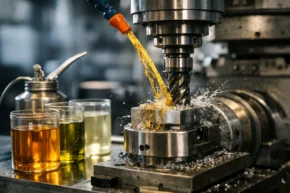
A tapping operation that produces clean threads at the start of a shift can become a source of torn surfaces, built-up edge, and broken tools before the day is over. Often, the change is not the machine or the tooling. It is the lubrication at the cutting zone. Cutting oils are engineered to control friction, manage heat, carry away chips, and protect both the tool and finished component during demanding machining.
The right product is not simply the oil with the highest lubricity or the lowest purchase price. Nutech has a machining oil to fit the alloy, operation amd cutting parameters required by your company. A product that performs well on low-carbon steel may stain yellow metals, create smoke in high-speed work, or leave a residue that interferes with welding, coating, or assembly.
What Cutting Oils Do at the Tool-Workpiece Interface
Metal cutting concentrates substantial force and heat into a very small contact area. As the cutting edge shears material, friction develops along the tool face and flank. Without sufficient boundary lubrication, the tool can weld microscopically to the workpiece, forming built-up edge. The result may be poor surface finish, dimensional variation, elevated torque, and premature tool wear.
Cutting oils form a lubricating film that reduces direct metal-to-metal contact. Nutech offers formulation with a variety additives packages that react under the pressure and temperature reducing scoring, galling, and localized welding. This is particularly valuable in tapping, broaching, reaming, deep-hole drilling, thread rolling, gear cutting, and other operations where the tool has prolonged contact with the part.
Oil also contributes to cooling, although straight oils generally remove heat less effectively than water-based metalworking fluids. That trade-off matters. In severe, low-speed operations, lubricity may be the primary requirement. In high-speed machining where heat removal and chip evacuation dominate, a soluble or semi-synthetic fluid may be the more effective process choice.
Selecting Cutting Oils by Operation
The operation should lead the selection process. A general-purpose oil may cover several jobs, but difficult applications often benefit from chemistry tailored to the cutting mechanism and material.
Tapping, Reaming, and Broaching
These operations place high loads on tool surfaces and leave little margin for lubrication failure. Tapping requires strong film strength because chips can pack in flutes and torque can rise quickly. Reaming depends on stable lubrication to protect edge finish and maintain bore quality. Broaching requires consistent lubricity across a long cutting stroke, particularly when machining internal features.
Nutech had a family of higher-viscosity oils and formulations with appropriate extreme-pressure or antiwear additives that are designed to meet these challenges. The correct additive system depends on the alloy. Active sulfur chemistry can provide strong performance on many ferrous alloys, but it may discolor copper, brass, and some aluminum alloys. Where nonferrous compatibility is required, inactive sulfur or alternative additive technology may be necessary.
Drilling and Deep-Hole Machining
Drilling requires a balance between lubricity and chip transport. An oil that is too heavy can make chip evacuation more difficult, while one that is too light may not prevent flank wear or built-up edge. In deep-hole drilling, fluid delivery pressure, filtration, and the oil’s ability to release air can be as important as its lubricity.
For high-production drilling, evaluate the complete system: tool geometry, coolant-through capability, delivery pressure, sump cleanliness, and fluid condition. Changing oil without addressing filtration or nozzle alignment may not correct a recurring tool-life problem.
Turning, Milling, and General CNC Work
Turning and milling often involve variable speeds, interrupted cuts, and multiple alloys on the same equipment. A lower-viscosity cutting oil can improve wetting, reduce drag, and help move chips away from the cut. However, lower viscosity alone does not guarantee better results. The formulation still needs sufficient boundary lubrication for the materials and feed rates being machined.
For shops machining carbon steel, alloy steel, stainless steel, aluminum, and brass across mixed production schedules, product versatility has value. Still, a single oil can involve compromise. A process producing difficult stainless components may justify a dedicated product if it reduces cycle interruptions, improves insert life, or lowers scrap.
Viscosity Is a Process Decision
Viscosity influences how effectively the oil reaches and remains in the cutting zone. Lighter oils generally flow more readily, penetrate tight tool-workpiece interfaces, and support high-speed applications. They can also provide cleaner parts and less residue. Heavier oils typically offer stronger film thickness and may perform better in severe forming or slow, high-load cutting.
There is no universal viscosity grade for machining. The best choice depends on material hardness, speed, feed, tool design, delivery system, and required surface finish. A shop may need different products for high-speed aluminum machining and heavy-duty stainless tapping, even if both operations occur in the same department.
Viscosity also affects misting and smoke. Excessive smoke can indicate an oil that is not suited to the operating temperature, poor fluid delivery, worn tooling, or aggressive cutting conditions. The response should be a process review, not an automatic switch to a thinner product. Reduced viscosity may lower smoke while sacrificing the film strength needed to protect the tool.
Additive Chemistry and Material Compatibility
Cutting oil performance is largely determined by its base oil and additive package. Polar lubricity agents improve boundary film formation. Antiwear additives help protect sliding surfaces. Extreme-pressure additives become important under severe loads, where they help reduce welding and tearing at the tool interface.
The chemistry must be compatible with the metals being machined and the downstream process. Some sulfurized products can stain copper-containing alloys. Certain additive packages may affect aluminum appearance or create residues that require more aggressive cleaning before coating, heat treatment, or welding. Parts destined for medical, aerospace, food-related, or tightly controlled finishing processes may have additional documentation and residue requirements.
Plant teams should also consider odor, operator exposure, mist control, and local environmental requirements. Product safety data and industrial hygiene practices remain part of fluid selection. A high-performing oil must also be practical to store, deliver, maintain, and manage within the facility.
Delivery and Maintenance Affect Results
Even a well-formulated product will underperform if it does not reach the cut. Flood delivery should be directed at the tool-workpiece interface rather than generally toward the work zone. Through-tool delivery can be especially valuable in drilling, tapping, and deep cavities because it transports lubricant directly to the highest-load areas.
Minimum quantity lubrication can reduce consumption and improve housekeeping in suitable applications, but it requires precise equipment setup and a product designed for that delivery method. It is not a direct substitute for flood application in every severe operation. Chip removal, heat load, and cycle time determine whether MQL is appropriate.
Straight cutting oils require routine management. Contamination from tramp oil may be less of a concern than in water-based systems, but fines, chips, moisture, and degraded residue can still affect performance. Effective filtration protects tool life and surface finish while extending usable fluid life. Monitor fluid appearance, odor, viscosity trends, water contamination, and machining results rather than waiting for a visible failure.
A Practical Evaluation Method for Cutting Oils
When a machining problem occurs, compare products under controlled conditions. Run the same material lot, tool type, speeds, feeds, and delivery settings whenever possible. Measure tool life, torque or spindle load, surface finish, chip control, dimensional consistency, smoke, residue, and cleaning performance. A short test based only on initial appearance can miss the cost impact of tool changes and downstream rework.
The lowest-priced fluid may not be the lowest-cost option. If a cutting oil extends tool life, reduces rejects, improves cycle stability, or prevents a secondary cleaning issue, its value can exceed the difference in purchase price. Conversely, a premium severe-duty oil may be unnecessary for an easy-turning alloy and moderate-speed operation.
Nutech Company works with manufacturers to align metalworking fluid chemistry with real production conditions, including machining severity, material compatibility, delivery equipment, and downstream requirements. The most useful recommendation is one that can be verified on the machine and maintained consistently on the plant floor.
When cutting performance begins to drift, treat the fluid as part of the process rather than a consumable in the background. A focused review of oil selection, application, and maintenance can turn recurring tool and finish problems into a more controlled, repeatable machining operation.