
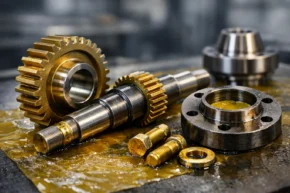
A finished steel component can leave the furnace clean and uniform, then develop staining before it reaches assembly. Machining coolant residues, heat-treat scale, fingerprints, humid plant air, and incompatible packaging can all compromise rust inhibited machined and heat treated parts. Effective protection is not a single product decision. It is a controlled sequence that begins before the part is treated and continues through storage, shipment, and final use.
For manufacturing teams, the cost of corrosion is rarely limited to surface appearance. Rust can create rejection at incoming inspection, interfere with close-tolerance assembly, damage customer confidence, and trigger unplanned sorting or rework. The right rust preventative, applied under the right conditions, helps protect part quality without creating downstream cleaning, coating, or welding problems.
Why Machined and Heat Treated Parts Need Different Protection
Machining and heat treatment create different surface conditions, and those conditions influence corrosion risk. A machined surface may carry metalworking fluid, fines, salts from water-based coolant, and handling contamination. A heat-treated part may have oxide, quenchant residue, carbonaceous deposits, or a freshly exposed surface after shot blasting, grinding, or straightening.
Heat-treated steel is especially vulnerable when parts move rapidly from a hot process to a cooler, humid environment. Condensation can form on surfaces that appear dry. Even a light film of moisture can initiate corrosion where residual salts or acidic contaminants remain. Parts with threads, blind holes, internal passages, and ground bearing surfaces create additional risk because solution carryover and trapped moisture are difficult to remove completely.
The required protection level depends on the part’s route after heat treatment. A component going directly to assembly may need only short-term indoor protection and easy removal. Parts entering overseas shipment, seasonal storage, or outdoor staging require a more durable film and better package-level moisture control. Protection should match actual exposure, not simply the longest protection claim on a product data sheet.
Start With Surface Preparation
A rust preventative cannot reliably compensate for an improperly cleaned or poorly dried part. Before application, the surface should be free of process residues that reduce film adhesion or attract moisture. This is particularly important after quenching, tempering, washing, shot blasting, grinding, or post-heat-treat machining.
Cleaning chemistry must be compatible with the alloy, soil load, and downstream process. Alkaline cleaners can remove oils and shop soils effectively, but rinsing must be controlled to prevent cleaner residue from remaining in holes and crevices. Water quality matters as well. High dissolved-solids water can leave deposits that undermine corrosion protection, particularly on precision-machined surfaces.
Drying deserves the same attention as cleaning. Compressed air can leave moisture behind in complex geometries, while inadequate oven drying may leave warm parts that later condense moisture as they cool. Ideally, parts are fully dry and near a stable handling temperature before rust preventative application. Applying a product to a hot component can lower viscosity and improve coverage in some applications, but it can also accelerate solvent evaporation, create an uneven film, or present a safety concern. Product selection and application parameters should be verified for the operating temperature.
Residual Quenchant Can Be a Hidden Variable
Quenchant residue is one of the most common sources of inconsistent protection after heat treatment. Oil residue may prevent a water-displacing rust preventative from reaching the metal surface. Conversely, a thin, compatible oil film may support protection when the selected preservative is designed to build on it.
The point is not that every part must be stripped to bare metal. It is that the surface condition must be known and repeatable. When corrosion appears intermittently, evaluate where the issue occurs in the process: after quenching, after washing, after inspection, or only after packaging. That timing often identifies whether the root cause is contamination, drying, application coverage, or storage exposure.
Select a Rust Preventative for the Actual Requirement
Rust preventatives are available as solvent-based, water-displacing, water-based, and oil-based systems, along with products that leave thin, soft, dry-to-touch, or heavier protective films. Each has practical advantages and limitations.
A thin-film product may be appropriate for machined parts that will be assembled soon or need minimal pre-cleaning. It can preserve dimensional feel and avoid excessive oil transfer during handling. Its limitation is exposure tolerance. Thin films may not provide enough protection for long storage periods, high humidity, or export packaging.
Water-displacing rust preventatives are often useful after aqueous cleaning, particularly when complete drying is difficult. These products can displace residual moisture and leave a protective film, but they still require proper drainage and process control. They should not be used as a substitute for correcting poor rinsing or excessive water carryover.
Heavier films generally provide more durable protection for long-term storage and challenging transport conditions. However, they may require a dedicated cleaning operation before coating, assembly, or welding. A plant should consider the full manufacturing route when selecting chemistry. The lowest-cost product per gallon can become the most expensive option if it creates cleaning delays, coating adhesion failures, or customer complaints.
For parts that will be painted, conversion coated, bonded, or welded, confirm downstream compatibility before implementation. Some rust preventatives are formulated for easy removal, while others are intended to remain on the part. A controlled trial with the actual material, surface finish, and packaging system is more reliable than assuming a product will perform identically across every part family.
Application Method Controls Coverage
Dip, spray, brush, roll, and automated flood application can all produce effective results. The best method is the one that provides repeatable coverage on the part geometry while controlling consumption, drainage, and worker exposure.
Dip application is effective for complex parts because it reaches recesses, threads, and internal features. It also requires attention to bath concentration, contamination, agitation, dwell time, and drain time. Drag-out increases product use and can create puddling that attracts dirt or complicates later cleaning.
Spray systems offer speed and can be integrated into automated lines, but nozzle positioning and pressure must reach all surfaces. Shadowed areas are a frequent source of corrosion on racked components. For parts with holes or cavities, orienting the part to promote drainage is as important as the spray pattern itself.
Film weight should be monitored rather than estimated by appearance alone. Too little film can leave vulnerable areas exposed. Too much can cause dripping, package staining, handling problems, and unnecessary chemical cost. A practical control plan may include concentration checks, viscosity checks where applicable, part-weight measurements, visual inspections, and periodic corrosion testing under representative conditions.
Packaging and Storage Are Part of Corrosion Control
A protected part can still rust if it is placed in wet packaging or exposed to repeated temperature swings. Cardboard, wood, dunnage, and returnable containers can carry moisture into the package. Parts packed while still warm can cool and create condensation inside a sealed bag or tote.
For extended storage or shipment, combine the rust preventative with packaging designed for the exposure level. Vapor corrosion inhibitor materials, barrier bags, desiccants, and sealed packaging may be appropriate, but each component must work with the selected preservative. For example, excessive oil on a part can reduce the effectiveness of some vapor-phase protection systems, while a package that is not properly sealed may make desiccant ineffective.
Storage location also matters. Keep finished parts away from exterior doors, unconditioned areas, wash stations, and locations subject to daily temperature cycling. First-in, first-out inventory practices reduce the chance that short-term protection is unintentionally asked to perform for months.
Troubleshoot Rust by Looking at the Entire Process
When corrosion occurs, replacing the rust preventative immediately may not solve the problem. Review the process from the last cleaning operation through final shipment. Identify the alloy and heat-treatment condition, residual soil level, rinse-water quality, part temperature at application, film weight, package configuration, storage duration, and environmental exposure.
Corrosion patterns offer useful clues. Rust concentrated in holes and threads often points to trapped water or inadequate drainage. Fingerprint-shaped staining suggests handling after protection. Corrosion at rack contact points can indicate incomplete coverage. Random spotting across a package may indicate condensation or contaminated packaging materials.
A technical supplier can help establish a process-specific protection plan that considers machining fluids, cleaners, heat-treat chemicals, rust preventatives, and downstream finishing requirements together. That integrated view is valuable because each chemical stage affects the next one.
Nutech Company supports manufacturers with industrial chemistry selected for real operating conditions, not just laboratory test panels. For machined and heat-treated components, the most dependable corrosion-control program is the one that treats cleaning, drying, preservation, packaging, and storage as one connected process. Start with the part’s actual exposure profile, validate performance on production material, and maintain the controls that keep protection consistent from the line to the customer.