
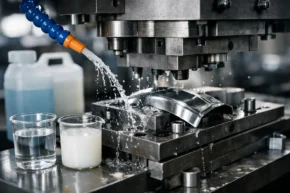
A stamping operation can hold press speed, die clearance, and material specifications within target, yet still produce galling, tearing, residue, or inconsistent part finish. The lubricant is often the variable connecting those outcomes. A properly selected water soluble stamping lubricant must provide boundary lubrication at the die interface while supporting downstream cleaning, welding, coating, and corrosion-control requirements.
For industrial stampers, the correct product is not simply the one that feels most slippery or leaves the cleanest panel. It is the formulation that delivers repeatable forming performance at the required concentration, application rate, and production speed without creating unnecessary load on washers, wastewater systems, or tooling maintenance.
What a Water Soluble Stamping Lubricant Must Do
Water-soluble stamping lubricants are typically supplied as concentrates that are diluted with water before use. Their chemistry may include lubricity additives, wetting agents, emulsifiers, corrosion inhibitors, extreme-pressure components, and polymers selected for the severity of the forming operation. When mixed and applied correctly, they create a controlled lubricating film between the workpiece and die surfaces.
The primary job is to reduce friction where metal flows across punches, dies, draw rings, and other tooling surfaces. Lower, more consistent friction helps prevent scoring, pickup, tearing, and excessive draw force. That performance must remain stable as the press runs, not only during a short setup trial with fresh fluid.
Formability Comes First, but It Is Not the Only Requirement
Deep drawing, severe bending, embossing, blanking, and progressive-die operations place different demands on the fluid. A light blanking application may need only modest lubricity and clean release. A deep-draw operation on stainless steel, high-strength steel, or aluminum may require a more tenacious film with stronger boundary lubrication.
More lubricity is not always better. A heavy film can interfere with part handling, contaminate sensors, overload a cleaning stage, or create weld-related concerns. The objective is sufficient lubricity for the most demanding contact zone while maintaining a stable, manageable process across the full line.
Cleanability Is a Process Requirement
Many stamping lubricants are selected with downstream operations in mind. If parts will be welded, painted, powder coated, plated, phosphated, or bonded, lubricant residue must be compatible with the established cleaning sequence. A product that protects the die but is difficult to remove can shift cost and quality problems to another department.
Water-soluble chemistry can offer an advantage where aqueous cleaning is available. However, cleanability depends on the lubricant formulation, the amount applied, washer temperature, cleaner concentration, spray impingement, and part geometry. Tight hems, drawn pockets, and stacked parts can retain fluid even when open surfaces appear clean.
Corrosion Protection Must Match the Production Window
Water-based lubricants introduce moisture to the process, so temporary rust prevention matters, particularly on cold-rolled steel and during humid conditions. The appropriate protection level depends on how long parts remain in process, whether they are washed promptly, and how they are stored or transported.
A lubricant with limited corrosion protection may be appropriate for parts moving directly from the press to a wash line. Operations that stage work-in-process for several days may need additional protection or a coordinated rust preventative after cleaning. These decisions should be made as part of the total manufacturing route, not as isolated pressroom choices.
Selecting a Water Soluble Stamping Lubricant by Application
The material being formed is a practical starting point. Mild steel can often run successfully with a broad range of fluids, while galvanized steel, aluminum, stainless steel, copper alloys, and high-strength grades each introduce different concerns. Surface finish, coating type, form severity, and susceptibility to staining or pickup all affect lubricant choice.
Consider Material and Tooling Together
Galvanized materials can be prone to coating pickup under high contact pressure. Aluminum may require chemistry that controls galling without staining or complicating subsequent finishing. Stainless steel often needs stronger boundary lubrication because of its tendency to work harden and gall. For each material, die surface condition and tooling material matter just as much as base-metal grade.
A polished, properly maintained die may run cleanly with a lower-film-strength product than a die with worn or damaged areas. Lubricant can compensate for some process stress, but it should not be used to mask incorrect clearances, rough tool surfaces, or misalignment. When pickup becomes chronic, evaluate the die, material condition, and fluid as one system.
Match Film Strength to Forming Severity
The most demanding operation in a progressive die normally determines the minimum lubricity requirement. Review draw depth, reduction, blank-holder pressure, contact area, and press speed. Also consider whether the lubricant is applied to one or both sides of the strip. A product that performs in a simple bend may fail in a redraw or high-pressure flange area.
Application method affects results. Roller coaters, spray systems, flood application, and prelubricated coil each produce different film consistency. Too little fluid produces local friction and variable part quality. Too much fluid can increase carryover, make parts difficult to handle, and add cleaning cost. Measuring film weight or application volume is more reliable than adjusting settings by appearance alone.
Account for Water Quality and Concentration Control
Water hardness, chlorides, alkalinity, and microbial load can alter emulsion stability, residue, corrosion performance, and sump life. A formulation that performs well with treated water may behave differently when mixed with hard municipal water. Testing with the actual plant water is preferable to evaluating a concentrate in laboratory conditions alone.
Concentration should be monitored using the appropriate method for the formulation, such as refractometer readings correlated to product concentration, titration, or supplier-recommended checks. Evaporation, drag-out, water additions, and contamination can change the working fluid over time. A consistent makeup practice prevents operators from unknowingly running below the concentration needed for protection and lubricity.
Managing the Fluid in Production
A water-soluble stamping fluid is a managed process chemical, not a set-and-forget supply item. Regular checks of concentration, pH, appearance, odor, tramp oil, and biological activity provide early warning of problems that can affect parts and equipment.
Tramp oil from press hydraulics, gearboxes, or other sources may reduce wetting, alter residue behavior, and support microbial growth. Leaks should be corrected rather than treated solely as a fluid-maintenance issue. Where a central system or recirculating sump is used, filtration, skimming, and periodic cleaning help maintain stable performance.
Use a Controlled Trial Instead of a Pressroom Guess
The best qualification process begins with a representative production trial. Establish baseline conditions for the incumbent product, including mix concentration, application method, press speed, tool condition, scrap rate, die maintenance frequency, and cleaning results. Then evaluate the candidate lubricant under the same conditions.
Inspect parts for scratches, galling, cracks, staining, and residue. Review draw force or press load where available, and include downstream teams in the evaluation. Welding, finishing, quality, maintenance, and environmental health and safety personnel may identify concerns that are not visible at the press. A successful trial should demonstrate performance through a meaningful run length, not just a few acceptable first pieces.
When Water-Soluble Chemistry May Not Be the Best Fit
Water-soluble lubricants are a strong option for many operations, especially where cleanability and aqueous-process compatibility are priorities. They are not automatically the best choice for every application. Extremely severe forming, long-term indoor or outdoor storage, limited access to controlled water quality, or absence of a practical cleaning process may favor a different lubricant technology.
The decision should balance part quality, tool life, washer capability, corrosion risk, labor, waste handling, and cost per good part. Concentrate price alone does not reveal operating cost. A fluid that improves die life, reduces scrap, and lowers cleanup requirements can deliver more value than a lower-priced product that demands frequent adjustment.
Nutech Company works with manufacturers to evaluate forming conditions and align lubricant chemistry with the broader production process, including cleaning, conversion coatings, and rust prevention where needed.
A stamping lubricant should make the process more predictable, not simply make the die feel slicker. Start with the hardest-to-form feature, validate the entire production route, and maintain the working solution with the same discipline applied to tooling and press setup.