
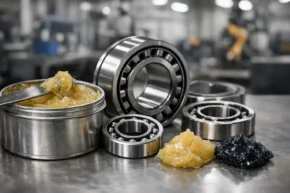
A bearing can fail long before rolling elements show visible damage. Excessive heat, noise, grease leakage, vibration, and corrosion often begin with a lubricant mismatch or an inconsistent relubrication practice. Selecting industrial grease for bearings requires more than choosing a familiar product grade. The grease must suit the bearing design, operating load, speed, temperature, environment, and maintenance method.
For industrial manufacturers, the objective is practical: maintain a stable lubricant film, keep contaminants away from contact surfaces, control friction and heat, and achieve predictable service intervals. The correct grease supports bearing life and uptime. The wrong grease can contribute to premature wear, unplanned shutdowns, higher grease consumption, and difficult cleanup issues.
What Industrial Grease for Bearings Must Do
Bearing grease is a lubricating oil held within a thickener structure. The oil performs the primary lubrication function, while the thickener releases oil gradually and helps the lubricant remain in the bearing. Additives may provide protection against oxidation, rust, wear, extreme pressure, or water washout.
This structure makes grease suitable for many applications where oil circulation is impractical or where a lubricant must stay in place. Electric motors, conveyor systems, pumps, fans, presses, machine tools, material-handling equipment, and process equipment all rely on properly lubricated rolling-element bearings.
A grease selection should be based on the operating condition, not simply on whether the equipment is indoors or outdoors. A high-speed spindle, a slow heavily loaded pivot, and a washdown conveyor bearing may all need very different grease properties. Using one multipurpose grease throughout a plant can simplify purchasing, but it may introduce performance compromises in critical applications.
Start With the Bearing Operating Conditions
The first question is what the bearing experiences in service. Load, speed, temperature, contamination, moisture, shock, and relubrication access all affect the appropriate formulation.
Load and shock loading
Heavily loaded bearings require sufficient oil film strength to separate rolling elements and raceways. In applications such as forging equipment, stamping presses, large conveyors, and gear-driven production machinery, a grease with antiwear or extreme-pressure additives may be appropriate. These additives can help prevent surface distress under high contact pressures.
However, extreme-pressure chemistry is not automatically the best choice for every bearing. Some additives may not be appropriate for high-speed, low-torque applications or for components with specific metallurgy. The bearing manufacturer’s guidance and the actual load profile should shape the decision.
Speed and base oil viscosity
Speed changes the lubrication requirement substantially. Slow-moving, heavily loaded bearings often benefit from a higher-viscosity base oil that can maintain film thickness. High-speed bearings generally need lower base oil viscosity to limit fluid drag, churning, and temperature rise.
This distinction is frequently missed when a grease is selected by NLGI grade alone. NLGI grade describes grease consistency, or relative firmness. It does not identify base oil viscosity or determine whether the grease is suitable for a particular speed factor. Two NLGI No. 2 greases can behave very differently in the same bearing because their base oils, thickeners, and additive packages differ.
Temperature range
Operating temperature affects both the base oil and the thickener. At low temperatures, grease may stiffen and resist movement, increasing torque and reducing oil release. At elevated temperatures, the base oil thins, oxidation accelerates, and the thickener may lose structure if its temperature capability is exceeded.
Do not select grease only by its dropping point. Dropping point is a laboratory indicator of thickener behavior, not a direct measure of usable bearing temperature. A grease can have a high dropping point and still provide limited oxidation life or poor oil retention at the application temperature. Continuous operating temperature, peak temperature, and exposure duration all matter.
Water, dust, and process contamination
Manufacturing environments can expose bearings to coolant mist, wash water, steam, metal fines, abrasive dust, chemicals, and scale. In these conditions, water resistance, corrosion protection, mechanical stability, and adhesion become central requirements.
A water-resistant grease may remain in place during washdown, but excessive contamination can still require shorter relubrication intervals. Grease is not a substitute for sound seals, shields, and contamination control. If a bearing repeatedly shows rusty grease, abrasive wear, or water intrusion, the maintenance response should examine the entire sealing and lubrication system.
Match the Thickener and Consistency to the Application
Thickener type influences water resistance, high-temperature capability, pumpability, shear stability, and compatibility with other greases. Lithium complex greases are commonly used across industrial equipment because they offer broad performance balance. Calcium sulfonate, aluminum complex, polyurea, clay, and other thickener systems may be selected where operating demands justify their specific strengths.
Polyurea grease, for example, is frequently used in electric motor bearings because of its oxidation stability and long-life characteristics. It may not be compatible with every grease already in service. Calcium sulfonate formulations can offer strong water resistance, corrosion protection, and load-carrying performance, making them useful in wet or demanding heavy-duty environments. The correct choice depends on the equipment and maintenance program, not on a single property.
Consistency also matters. NLGI No. 2 is common for manually greased bearings and general industrial use. Softer grades may be needed in centralized lubrication systems or at lower temperatures where pumpability is critical. Firmer greases may be used where retention is especially difficult, although overly stiff grease can restrict flow and increase churning in some applications.
Verify Compatibility Before Changing Products
Mixing incompatible greases can soften or harden the lubricant, reduce mechanical stability, separate oil from the thickener, or limit high-temperature performance. Compatibility is especially relevant when equipment arrives with factory-fill grease, when maintenance teams consolidate inventory, or when a plant changes suppliers.
A compatibility chart can provide preliminary direction, but it should not be treated as final approval for a critical application. Base oil type, thickener chemistry, operating temperature, and the proportion of each grease affect the outcome. When a change is necessary, the preferred approach is to purge as much old grease as practical, clean accessible components, and monitor bearing temperature, noise, and grease condition during the transition.
This is also a reason to maintain clear lubrication records. Product name, grease type, application point, relubrication quantity, interval, and observations should be documented. A grease gun without identification is a preventable reliability risk.
Apply the Right Amount at the Right Interval
Overgreasing is one of the most common bearing lubrication errors. Excess grease can churn inside the housing, raising temperature and accelerating oxidation. In electric motors, overgreasing can push lubricant into windings or create seal damage. Under-greasing, on the other hand, leaves insufficient lubricant to maintain film strength and contaminant protection.
Relubrication quantity and frequency should reflect bearing size, speed, housing design, operating temperature, contamination exposure, and grease type. A clean, lightly loaded bearing operating at moderate speed may need relatively infrequent attention. A bearing near a forging line, washdown area, or dusty transfer point may require a much tighter interval.
Condition monitoring can improve these decisions. Temperature trends, ultrasound, vibration analysis, grease sampling, and visual inspection can identify whether an interval is too long, too short, or appropriate. The goal is not to add grease on a calendar without question. It is to maintain reliable lubrication with minimum waste and minimum disruption.
Warning Signs That Merit a Grease Review
A review is warranted when equipment behavior changes after relubrication or when recurring bearing issues appear in one process area. Common indicators include:
- Rising bearing temperature or a temperature spike after grease application
- Grease purging from seals, housings, or motor end bells
- Rusty, gritty, hardened, or separated grease found during inspection
- Repeated bearing noise, vibration, or short service life under normal loads
These symptoms do not always mean the grease is the sole cause. Misalignment, improper fit, shaft damage, electrical fluting, excessive load, and ineffective seals can produce similar results. Still, grease selection and application practice should be part of every root-cause review.
Build Grease Selection Into the Maintenance Strategy
The best industrial grease program connects lubricant chemistry with equipment reliability, production conditions, and maintenance execution. It begins with a clear list of bearing applications and their operating demands. From there, plant teams can reduce unnecessary product overlap while preserving specialized greases where speed, heat, water, load, or process contamination require them.
Nutech Company, LLC supports industrial operations with lubrication products and technical service designed around process-specific performance requirements. For bearing applications, the useful starting point is not a generic recommendation. It is a review of the machine, environment, existing lubricant, failure history, and maintenance method.
A bearing grease should earn its place in the plant by controlling friction, resisting the actual environment, and supporting a repeatable maintenance interval. When those factors are aligned, lubrication becomes a controlled part of equipment reliability rather than a recurring source of avoidable downtime.