
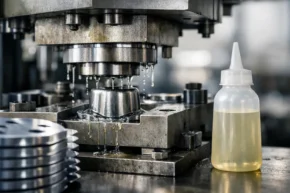
A lubricant that works on a shallow blanking operation can fail quickly when the same material moves into a deep draw. Metal stamping and drawing lubrication must manage friction, heat, metal flow, and tool protection at the same time. The right chemistry supports stable production; the wrong chemistry can show up as galling, splits, scuffing, poor surface finish, excessive die maintenance, and inconsistent press performance. Nutech’s NuDraw HP is a concentrated semi-synthetic forming fluid that is formulated with proprietary preformed emulsion technology that possess vary small particle size. NuDraw HP offers exceptional boundary lubrication for ferrous and non-ferrous materials with exceptional corrosion control. Designed for light to the most severe forming operations the extreme pressure additives enhance forming performance. NuDraw HP has tremendous wetting and hard water stability characteristics and is easily removed.
What the Lubricant Must Do
Stamping and drawing lubricants create a controlled film between the workpiece and the die. That film reduces metal-to-tool adhesion while allowing the sheet, strip, tube, or wire to flow as intended. In demanding operations, the lubricant must remain in place under high contact pressure rather than being displaced at the first point of severe deformation.
Effective lubrication also helps control heat generated by friction. Heat can thin a lubricant film, accelerate wear, alter surface appearance, and contribute to built-up material on punches and dies. For manufacturers running high-volume press lines, even a small reduction in friction can improve consistency across long production runs.
The required balance depends on the operation. A blanking or light-forming process may prioritize clean application, easy downstream removal, and corrosion protection. Deep drawing, ironing, and severe forming require stronger boundary lubrication and greater film strength. Selecting a product solely by viscosity or appearance does not account for these different demands.
Selecting Metal Stamping and Drawing Lubrication
Material type is the first major selection factor. Low-carbon steel, high-strength steel, stainless steel, aluminum, copper, and coated materials each present different friction and adhesion characteristics. Stainless steel and high-strength alloys commonly demand more aggressive lubricity because of their tendency to gall and the higher forces involved. Aluminum requires chemistry that prevents pickup and surface marking without interfering with cleaning, welding, coating, or finishing requirements.
Part geometry matters just as much. The severity of a draw is affected by draw depth, radius design, reduction, blank-holder pressure, die clearance, and the number of forming stages. A product that performs well on a simple cup may not provide adequate protection on a part with tight radii, re-strikes, or multiple draws.
Process conditions complete the selection picture. Press speed, application method, lubricant consumption, tool temperature, and the need for post-process cleaning should be reviewed together. For example, a high-speed progressive die may require a low-residue fluid that applies consistently in small volumes. A heavy draw may benefit from a higher-film-strength compound applied directly to critical deformation zones.
Application Control Is Part of Lubrication Performance
A capable lubricant cannot compensate for inconsistent application. Uneven coverage creates dry spots that become localized sources of galling and scoring. Excess application, however, can increase consumption, contaminate equipment, complicate cleaning, and create housekeeping concerns.
Roll coating, spray systems, dip application, and manual application all require control of volume and coverage. Production teams should verify that lubricant reaches high-pressure areas, including draw beads, radii, punch shoulders, and areas subject to material holdback. Monitoring should also account for changes in coil condition, incoming material coatings, and die temperature during extended runs.
Compatibility with downstream operations is essential. Some parts move directly to washing, welding, phosphating, conversion coating, painting, heat treatment, or rust prevention. Lubricant residues must be removable with the available cleaning process and must not create defects in subsequent finishing steps. The lowest-cost product per gallon can become the highest-cost option when it causes cleaning failures or rework downstream.
Signs the Current Process Needs Review
Lubrication issues are often blamed on tooling alone. Tool condition is critical, but recurring defects can indicate that the lubricant, application method, or process window no longer matches the operation. A technical review is warranted when production experiences four or more of the following conditions:
- Galling, material pickup, or scoring on punches, dies, and formed surfaces.
- Increased splits, tearing, wrinkling, or variation in draw quality.
- Higher press loads, more frequent die polishing, or shortened tool life.
- Residue that interferes with cleaning, welding, coating, or corrosion protection.
- Excessive lubricant use, misting, floor contamination, or inconsistent application.
The corrective action may involve changing lubricant chemistry, but it may also include adjusting application volume, die clearances, material handling, cleaning controls, or tool-surface condition. The best results come from evaluating the full forming system rather than treating lubricant as an isolated consumable.
A Process-Specific Approach Delivers Better Value
For plant teams, the goal is not simply to reduce friction. It is to produce acceptable parts at target rates with predictable tool life, manageable cleaning, and controlled operating cost. That requires lubricant selection based on the actual material, geometry, press conditions, and downstream requirements.
Nutech supports stamping and drawing operations with industrial lubricant formulations and technical service tailored to production conditions. A focused trial that measures part quality, die condition, consumption, and cleanup performance can identify whether a change in lubrication will provide measurable value without disrupting the rest of the manufacturing process.