
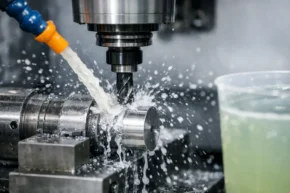
A coolant problem rarely stays confined to the sump. When metalworking coolants are poorly matched or poorly maintained, the effects show up as shortened tool life, heat discoloration, poor surface finish, corrosion, operator complaints, and unplanned downtime. For manufacturing operations, fluid selection is a process decision that affects quality, throughput, and total operating cost. Nutech’s latest semi=synthetic NuCool 3350 Plus is formulated for the most demanding metalworking operations while providing long maintenance free operation. NuCool 3350 Plus lubricates like an oil, dissipates heat like a water quenchant and is exceptionally clean. It has unrivalled film strength and boundary lubrication while providing a safe smoke & mist free shop atmosphere. You can expect extremely long service life with NuCool 3350 Plus with exceptional corrosion control.
What Metalworking Coolants Must Do
The primary job of a metalworking fluid is to manage the heat and friction created where the tool contacts the workpiece. In machining and grinding, effective cooling helps control thermal distortion, protects cutting edges, and supports consistent part dimensions. Lubricity reduces friction, limits built-up edge, and improves finish quality, particularly in demanding operations involving stainless steel, high-nickel alloys, aluminum, or difficult-to-machine steels.
A capable coolant must do more than cool and lubricate. It must provide corrosion protection for parts and machine surfaces, reject tramp oil, control foam, remain stable in hard or soft water, and support a clean operating environment. The correct balance depends on the process. A high-speed grinding operation may place cooling and low-foam performance first, while broaching, tapping, or deep-hole drilling may require greater boundary lubrication and extreme-pressure capability.
Selecting Metalworking Coolants by Operation
There is no universal best fluid. The right formulation begins with the operation, workpiece material, tooling, machine design, water quality, and downstream requirements.
Water-dilutable soluble oils are widely used because they provide a practical balance of cooling, lubricity, corrosion protection, and economy. They can be well suited to general machining of ferrous metals and many mixed-material operations. Semi-synthetic fluids typically offer improved cleanliness, cooling, and fluid life while retaining useful lubricity for broad machining applications. Fully synthetic fluids are often selected where high cooling capacity, low residue, and clean machine conditions are priorities, including certain grinding and high-speed machining applications.
Straight cutting oils are used where lubrication demand exceeds the value of water-based cooling. They are common in severe forming, threading, broaching, honing, and selected gear-cutting operations. Their trade-off is heat removal and housekeeping. A process engineer should evaluate cycle time, heat load, fire risk, mist control, and post-process cleaning before moving to or from a straight oil.
Material compatibility is equally important. Aluminum may require fluids that minimize staining and residue, while cast iron applications need strong corrosion control and good particulate handling. Copper alloys can discolor with incompatible chemistry. A fluid that performs well on one material may create quality or maintenance issues in a mixed-metal shop.
Do Not Overlook Downstream Processes
Coolant residue can affect cleaning, welding, coating, conversion coating, heat treatment, and rust prevention. If a component moves directly from machining to a finishing process, the coolant should be reviewed as part of the full production sequence. Compatibility testing can prevent avoidable adhesion failures, surface defects, or cleaning bottlenecks later in the line.
Concentration and Water Quality Drive Performance
Even a properly selected coolant will not perform consistently at the wrong concentration. Running too lean can reduce lubricity and corrosion protection, increase bacterial activity, and shorten tool life. Running too rich raises chemical consumption, may increase residue or foam, and can create cleaning challenges.
Concentration should be verified with the appropriate control method, commonly a refractometer supported by the supplier’s correction factor. The target range should reflect the specific operation, not simply the lowest allowable concentration. Severe machining, for example, may need a richer mix than light-duty milling.
Water quality changes the behavior of the finished fluid. Excessive hardness can destabilize some emulsions and leave deposits. Very soft water can increase foaming. Chlorides and sulfates may contribute to corrosion concerns. Before changing fluid chemistry to solve a recurring problem, evaluate the makeup water and the actual concentration in use.
Maintenance Protects Fluid Life and Machine Reliability
Coolant maintenance is not limited to adding makeup fluid. A controlled program includes regular concentration checks, pH monitoring, tramp-oil removal, sump cleaning, filtration, and microbiological observation. These activities help maintain fluid performance while reducing disposal frequency and unexpected production interruptions.
Tramp oil deserves particular attention. Hydraulic leaks, way lubricants, and spindle oils can form a surface layer that interferes with coolant oxygenation and encourages microbial growth. It can also contribute to smoke, mist, odor, and residue. Mechanical skimmers, coalescers, and leak correction are often more effective than repeatedly adding chemical treatment.
Chips and fines should be removed before they settle into sumps and restrict flow. Grinding swarf, cast iron fines, and aluminum particles can create abrasive wear, corrosion, and pump issues when filtration is inadequate. The appropriate filtration strategy depends on particle size, coolant type, and the surface-finish requirements of the operation.
Diagnosing Common Coolant Problems
A structured review prevents trial-and-error fluid changes. If foam develops, check concentration, water hardness, return-line design, pump conditions, and contamination before assuming the formulation is at fault. If rust appears, evaluate concentration, fluid age, machine cleanliness, water chemistry, part handling time, and the effectiveness of the downstream rust preventative.
Odor and shortened sump life usually point to contamination, poor circulation, excessive tramp oil, or weak concentration control. Tool wear may be caused by inadequate lubricity, but it can also result from incorrect feeds and speeds, tooling geometry, poor fluid delivery, or filtration problems. The fluid should be assessed as one part of the manufacturing system.
Nutech supports metalworking operations with established and application-specific fluid chemistry, backed by technical service for difficult machining, grinding, forming, and protection requirements. The most productive coolant program aligns the formulation, water, equipment, maintenance practices, and downstream processes around the actual conditions on the shop floor.