
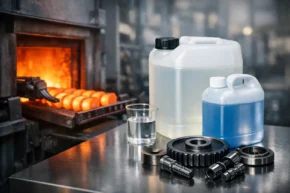
A heat-treat line can produce parts that meet hardness requirements yet still create downstream problems: distortion, stain, scale, soft spots, corrosion, difficult cleaning, or inconsistent response from one load to the next. Heat treatment chemicals affect each of those outcomes. They are process materials, not interchangeable shop supplies, and their selection should be tied to alloy, furnace cycle, part geometry, cleanliness requirements, and the operation that follows.
For manufacturers running carburizing, hardening, annealing, tempering, induction hardening, or other thermal processes, chemical control supports repeatable metallurgical results and more predictable operating cost. The right product package helps protect both the part and the equipment around it.
Where Heat Treatment Chemicals Fit in the Process
Heat treatment is often discussed as a temperature-and-time discipline. In production, however, the chemical condition of the part before, during, and after the furnace cycle is equally relevant. Residual machining fluid, drawing compound, or stamping lubricant can carbonize, stain surfaces, interfere with atmosphere control, and increase cleaning demands. Quench media determines how rapidly and uniformly heat leaves the part. Post-treatment protection determines whether a finished part remains corrosion-free during storage and shipment.
A complete approach typically includes pre-cleaning chemistry, quench oils or water-glycol polymer quenchant, stop-off paints where selective hardening or carburizing is required, and rust preventatives after processing. Some operations also require salt-bath materials, soot-control products, specialty lubricants for related handling equipment, or conversion coatings before a subsequent finishing process.
The key point is that these materials must work as a system. A cleaner that leaves an alkaline residue, for example, may affect quench behavior or create staining. A rust preventive that is difficult to remove can complicate assembly, welding, painting, or coating. Evaluating each chemical independently can miss the source of a recurring quality issue.
Quench Media: Control Cooling, Not Just Speed
Quenching is usually the most visible chemical decision in a heat-treat operation. Its purpose is not simply to cool a part as quickly as possible. The objective is to achieve the cooling curve required for the alloy and section thickness while limiting distortion, cracking, soft spots, and inconsistent hardness.
Quench Oils
Quench oils are used where controlled cooling, good wetting, and predictable metallurgical response are required. Their performance depends on more than viscosity. Cooling characteristics, flash point, oxidation stability, sludge control, water tolerance, and additive package all affect day-to-day results.
A faster oil can be appropriate for some alloy steels and demanding hardenability requirements, but it may increase distortion risk on thin, complex, or closely toleranced parts. A slower or more controlled oil may better protect geometry, although it may not provide enough cooling severity for every application. Part loading, agitation, transfer time, bath temperature, and contamination level can change results even when the oil grade remains the same.
Oxidation control matters because aged quench oil can thicken, form deposits, generate smoke, and lose consistency. Routine testing for viscosity, water, total acid number, and cooling performance provides a clearer picture of the bath than visual inspection alone. Filtration and proper tank maintenance help extend useful fluid life and reduce carryover into washers and tempering ovens.
Water-Glycol Polymer Quenchants
Water-glycol polymer quenchants provide adjustable cooling through concentration control. Increasing polymer concentration generally reduces cooling severity, allowing an operation to tune the process for alloy, geometry, and hardness targets. These products can be especially useful where fire-resistance considerations, cleanliness, or process flexibility are priorities.
The trade-off is that polymer systems demand disciplined concentration control. Evaporation, dragout, water additions, contamination, and bath temperature can shift performance. A refractometer reading is useful, but it should be correlated with the specific product, operating conditions, and metallurgical results. Foam control, agitation, microbial condition, and residue on parts also deserve attention.
Neither oil nor polymer is automatically the better option. The appropriate quenchant depends on the required cooling curve, safety objectives, washer capacity, part design, equipment configuration, and total operating cost.
Surface Preparation Before the Furnace
Heat-treat defects often begin before parts enter the furnace. Oils, greases, metalworking fluids, rust preventatives, shop soils, and fingerprints can leave carbonaceous residue or cause nonuniform surface appearance. In controlled-atmosphere applications, excessive contamination can also burden the furnace atmosphere and create avoidable maintenance issues.
Industrial cleaners for heat-treat operations should remove the specific soils present without attacking the substrate or leaving troublesome residue. Spray washers, immersion tanks, ultrasonic systems, and multi-stage cleaning lines each require a different balance of detergency, alkalinity, wetting, foam control, and corrosion protection.
Cleaning performance should be measured at the point of use. A part that appears clean may still carry residues that affect quenching, brazing, coating, or final inspection. Water-break testing, residue checks, washer concentration monitoring, and periodic review of nozzle condition and filtration can identify problems before they become a reject trend.
Stop-Off Paints for Selective Treatment
Stop-off paints are used to prevent carburizing, nitriding, or other surface reactions in areas that must remain machinable, dimensionally stable, or free of a hardened case. They are common on threads, bores, sealing faces, and surfaces scheduled for subsequent machining.
An effective stop-off coating must adhere through handling and the furnace cycle, provide complete coverage at the required film thickness, and be removable without excessive labor. Application method matters. Brushing may suit low-volume or irregular parts, while dipping, spraying, or automated dispensing can improve consistency at higher volumes.
Overapplication can create drying delays, chipping, or difficult removal. Underapplication or poor edge coverage can allow localized case formation. For that reason, stop-off selection should be validated on actual parts and actual furnace cycles, not only by reviewing a product data sheet.
Post-Treatment Corrosion Protection
Freshly heat-treated steel can rust quickly after washing, grinding, or exposure to humid plant conditions. A rust preventive provides temporary protection during in-process storage, shipment, or staging before assembly. The appropriate film can range from light, easily removable protection to a more durable barrier for longer storage or harsher environments.
Film type should match the next operation. A water-displacing product may be useful when parts leave a washer with residual moisture. A thin oily film can protect parts without creating excessive handling mess. A heavier solvent or oil-based coating may provide longer protection but can require more cleaning before painting, welding, or assembly.
Corrosion protection should be tested in the same conditions parts will encounter: returnable packaging, stacked totes, outdoor transit, coastal humidity, or extended indoor storage. Lab testing is valuable, but packaging design, part temperature at application, film coverage, and trapped moisture often determine real-world success.
Managing Chemical Condition and Carryover
The best formulation cannot compensate for poor bath control. Water in quench oil, excessive oil carryover into washers, depleted cleaner concentration, scale accumulation, and inadequate filtration can all affect quality and operating cost. Chemical management should be treated as part of process control, with documented checks, defined action limits, and clear responsibilities.
Useful monitoring programs vary by operation, but commonly include quench-oil condition, polymer concentration, cleaner concentration, washer pH, rust-preventative film performance, and contamination levels. Trend data is more valuable than isolated readings because it shows whether a process is drifting before the effects appear in hardness results, surface finish, or corrosion claims.
Technical service is especially valuable when several chemical families interact. A supplier with experience in metalworking fluids, cleaners, heat-treat products, stop-off paints, and rust preventatives can evaluate carryover across the production route rather than treating each tank as a separate problem.
Selecting a Chemical Program for the Actual Process
A practical evaluation starts with the part and the production objective. Identify the alloy, section thickness, hardness or case-depth requirement, dimensional tolerance, furnace type, quench equipment, throughput, cleaning method, and post-treatment handling. Then assess the soils arriving from upstream operations and the condition required for downstream assembly, coating, or shipment.
Plant teams should also account for safety, ventilation, fire considerations, waste handling, operator exposure, and the labor required to maintain each system. Lower purchase price does not necessarily mean lower cost if a product increases smoke, rejects, washer loading, cleaning time, or disposal frequency.
Nutech Company supports industrial manufacturers with heat-treating chemicals and related cleaners, stop-off paints, metalworking fluids, and rust preventatives selected for process-specific requirements. The goal is consistent performance across the production route, not a one-size-fits-all chemical recommendation.
When parts leave the heat-treat department clean, dimensionally stable, protected, and ready for the next operation, the chemical program is doing more than supporting a furnace cycle. It is helping the entire manufacturing process run with fewer preventable variables.