
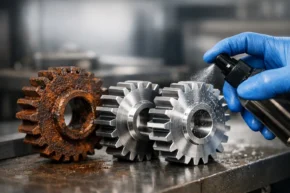
A finished steel part can begin to corrode long before it reaches a customer. Residual moisture after washing, fingerprints from handling, trapped humidity in packaging, and short-term outdoor exposure can all create conditions for flash rust or more serious corrosion. Rust inhibitors are therefore not simply a warehouse chemical. They are a process-control tool that helps manufacturers protect part quality, maintain production flow, and avoid preventable rework.
For machine shops, stampers, forgers, heat-treatment operations, and fabricators, the right protection program depends on more than the alloy being processed. It must account for the full path from machining or forming through cleaning, storage, assembly, and shipment. Chemistry, application method, film characteristics, downstream compatibility, and environmental conditions all affect results.
What Rust Inhibitors Do in Manufacturing
Rust is an electrochemical reaction that requires metal, oxygen, and moisture. Contaminants such as chlorides, acidic residues, process water, and handling soils can accelerate the reaction. A rust preventative works by interrupting those conditions, commonly through a protective barrier film, surface-active corrosion inhibitors, water displacement, or a combination of these mechanisms.
Oil-based rust preventatives generally leave a water-repelling film that separates the metal surface from moisture and oxygen. They are widely used for in-process protection, indoor storage, and shipment where a light, medium, or heavy film is acceptable. Film thickness is a practical trade-off: heavier films can provide longer protection, but may require more cleaning before assembly, coating, or further machining.
Water-based products can provide effective temporary protection where lower VOC content, cleaner working conditions, or easier removal are priorities. They may be applied by spray, dip, or recirculating systems. Their performance depends heavily on concentration control, water quality, drying conditions, and contamination management. A water-based product that is suitable for a short indoor holding period may not provide adequate protection for humid storage or export shipment.
Some applications require dry-to-touch films, barium-free formulations, low-residue protection, or compatibility with subsequent paint, welding, phosphating, or adhesive bonding. This is why selecting rust inhibitors by label description alone often produces inconsistent results. The application requirements should drive the chemistry.
Selecting Rust Inhibitors by Exposure and Process
The first selection question is simple: how long must the metal remain protected, and under what conditions? A machined component moving to assembly within 24 hours has a different requirement than a forged part stored for six months or a precision component shipped through changing climates.
Consider the Metal and Surface Condition
Ferrous metals are the most common concern, but corrosion behavior varies among cast iron, carbon steel, alloy steel, galvanized surfaces, and mixed-metal assemblies. Cast iron may retain moisture and process residues in its porous surface. Freshly ground or machined steel can flash rust quickly after exposure to aqueous fluids. Highly polished surfaces may show staining or discoloration that would be unacceptable even when the base metal is not deeply corroded.
Surface condition matters as much as alloy type. Parts leaving a cleaner with residual alkalinity, salts, or poor rinse water can corrode despite application of a capable preventative. Metalworking fluid carryover can also interfere with film formation. When corrosion appears inconsistent from lot to lot, the source may be cleaning, rinsing, drying, or handling rather than the rust preventative itself.
Define the Protection Interval
Protection targets should be specific. Indoor protection in a climate-controlled facility, covered storage in an unconditioned warehouse, temporary work-in-process storage, and long-distance shipment are not interchangeable conditions. Packaging adds another variable. A tightly wrapped part can retain moisture if packed before it is dry, while vapor corrosion inhibitor packaging may extend protection when used with a compatible surface treatment.
For longer storage periods, evaluate the product under the actual conditions parts will experience. Seasonal humidity, temperature cycling, coastal air, and outdoor staging can all shorten the effective protection interval. The most economical product is not necessarily the lowest-cost drum. It is the one that achieves the required corrosion protection without excess application, cleanup, or rejected parts.
Match the Film to Downstream Operations
A rust preventative should support the next process rather than create a new problem. If parts will be painted, powder coated, phosphated, welded, bonded, or assembled with tight tolerances, verify whether the protective film must be removed and how it will be removed. Some light films can be displaced or cleaned easily. Other products are designed for severe exposure and may require a more aggressive cleaning step.
For parts that will be machined again, a light lubricating rust preventative may provide both short-term corrosion protection and useful boundary lubrication. For wire, strip, or formed parts, the product must wet the surface consistently without creating excessive drag, staining, or residue accumulation. In heat-treatment environments, protective residues must also be considered in relation to furnace cleanliness and post-treatment finishing.
Application Method Determines Protection Quality
Even well-formulated rust inhibitors can fail when application is poorly controlled. The objective is a continuous, uniform film over all critical surfaces, including threads, bores, recesses, and part interfaces where water can collect.
Dip application offers thorough coverage for complex geometries and high-volume production. It requires attention to immersion time, drainage, tank cleanliness, and drag-out. Spray application is useful for automated lines and large components, but nozzle selection, spray pressure, part orientation, and coverage verification matter. Roll coating or brushing may fit strip, plate, or localized touch-up operations, though manual methods can introduce variation.
Application temperature affects viscosity, wetting, and drainage. A product that is too cold may leave a heavier-than-intended film or fail to reach recessed features. Parts should be sufficiently clean and dry before treatment unless the selected chemistry is specifically designed to displace water. Applying a standard oil film over standing water can trap moisture against the surface rather than prevent corrosion.
Drying and handling also deserve control. Allow appropriate drain and dry time before packaging. Avoid stacking parts while residual water, cleaner, or protective fluid is still migrating from holes and cavities. Gloves, clean racks, and clean packaging materials reduce the chance that salts and fingerprints will compromise protected surfaces.
Common Causes of Rust Preventative Failure
Corrosion complaints often lead directly to a request for a stronger product. Sometimes that is the correct response, but process conditions should be checked first. Four recurring issues deserve attention:
- Poor cleaning or rinsing: Cleaner residues, salts, and hard-water deposits can reduce film performance and initiate corrosion.
- Inadequate drying: Moisture trapped in seams, holes, or packaging can defeat a protective film.
- Insufficient coverage: Thin films, missed surfaces, poor spray patterns, and depleted dip tanks create weak points.
- Exposure beyond the design target: A product intended for short-term indoor storage may fail during extended shipment, outdoor staging, or high-humidity storage.
Contamination can be equally significant. Water entering an oil-based tank, bacterial activity in aqueous systems, tramp oil, metal fines, and depleted inhibitor concentration can change performance over time. Routine inspection and simple control checks are usually less costly than sorting corroded inventory.
Validate Protection Before Full-Scale Use
A practical trial should reproduce the actual manufacturing sequence. Use representative alloys, surface finishes, cleaning conditions, application equipment, packaging, and storage environment. Test parts from normal production rather than ideal laboratory coupons whenever possible. Production parts reveal drainage issues, residual soils, and geometry-related coverage gaps that flat panels may not show.
Evaluate more than visible red rust. Look for staining, water spots, fingerprint corrosion, residue that interferes with downstream work, and changes in appearance after unwrapping. Confirm that operators can apply the product consistently at production speed and that the required cleanup method is available when parts move to the next operation.
Technical support is particularly valuable when corrosion occurs at the intersection of processes, such as after aqueous machining, alkaline cleaning, heat treatment, or conversion coating. In these cases, adjusting cleaner concentration, rinse quality, drying, application rate, or packaging may deliver a better result than changing the rust preventative alone.
Nutech Company works with manufacturers that need corrosion protection aligned with broader metalworking, cleaning, finishing, and handling requirements. A coordinated approach helps prevent one process chemical from solving an immediate problem while creating difficulty in the next operation.
The right protection program should make corrosion control routine rather than reactive. Define the exposure, verify the surface condition, apply a consistent film, and test the complete production path. That discipline protects metal, preserves customer-facing quality, and gives production teams one less source of avoidable disruption.